
Xanthorhoe ferrugata
(Clerck, 1759)
Dark-barred Twin-spot Carpet
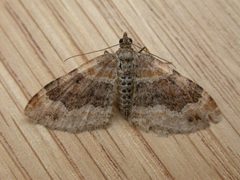
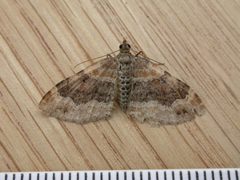
A Holarctic geometrid with two per year in Central Europe. fly from late April to early July and again from early July to mid-September. The exhibits wing pattern variation including a common melanistic aberration (ab. unidentaria) with a black band rather than the typical reddish or purplish band. Larvae feed on herbaceous plants in several .

Pronunciation
How to pronounce Xanthorhoe ferrugata: //zænˈθɔr.oʊ ˌfɛr.uˈɡeɪ.tə//
These audio files are automatically generated. While they are not always 100% accurate, they are a good starting point.
Identification
Difficult to distinguish reliably from Xanthorhoe spadicearia; reference to Townsend et al. suggested for separation. The nominate form with reddish band may be confused with other Xanthorhoe ; the black-banded aberration ab. unidentaria is distinctive but represents the same species. Xanthorhoe biriviata and Xanthorhoe vidanoi mentioned as additional similar species requiring careful comparison.
Images
Distribution
Holarctic. Europe eastward through Russian Far East, Siberia, Tibet and China; south to Caucasus and Turkey. North America from Alaska and Newfoundland south to North Carolina and California.
Seasonality
Two annually in Central Europe: late April to early July, and early July to mid-September. First generation larvae present August to September; second generation larvae June to July. Pupae of first generation overwinter.
Diet
Larvae feed on Galium, Stellaria, Campanula, and Cirsium . feeding habits not documented.
Host Associations
- Galium - larval food plant
- Stellaria - larval food plant
- Campanula - larval food plant
- Cirsium - larval food plant
Life Cycle
in Central Europe. First : laid spring, larvae develop August–September, pupae overwinter. Second generation: larvae develop June–July, pupae presumably give rise to second or may enter . Detailed egg and early instar descriptions not available.
Similar Taxa
- Xanthorhoe spadiceariaExtremely similar in appearance; reliable separation requires reference to Townsend et al.
- Xanthorhoe biriviataSimilar wing pattern requiring careful comparison for identification.
- Xanthorhoe vidanoiSimilar wing pattern requiring careful comparison for identification.
More Details
Subspecies
Multiple described: X. f. ferrugata ( nominate ); X. f. fuscata (Nordström, 1935) — not universally recognized; X. f. alaskae (Alaska, Yakutat); X. f. bilbainensis (Spain, Bilbao) — validity questioned; X. f. infumata (USA, Oregon Crater Lake); X. f. malaisei (Kamchatka).
Genetic variation
Aberration ab. unidentaria has been demonstrated through extensive breeding experiments to be an almost perfect Mendelian recessive, differing from the typical form only in having the band black rather than reddish.