
Eulithis
Hübner, 1821
grapevine loopers, spinach moths, chevron moths
Species Guides
13- Eulithis destinata
- Eulithis diversilineata(lesser grapevine looper)
- Eulithis explanata(White Eulithis Moth)
- Eulithis flavibrunneata
- Eulithis gracilineata(Greater Grapevine Looper Moth)
- Eulithis luteolata
- Eulithis mellinata(The Spinach)
- Eulithis molliculata(Dimorphic Eulithis Moth)
- Eulithis propulsata(Currant Eulithis Moth)
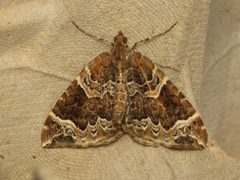
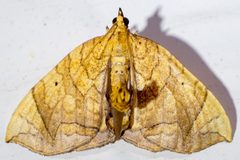
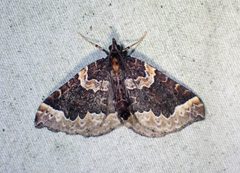
Eulithis is a Holarctic of geometrid moths in the tribe Cidariini, established by Jacob Hübner in 1821. The genus contains approximately 25 described distributed across the Northern Hemisphere. Several species are notable for their distinctive wing patterns, including chevron markings, and some have acquired reflecting their larval plants or wing patterns, such as the grapevine loopers and spinach .
Pronunciation
How to pronounce Eulithis: //juːˈlaɪθɪs//
These audio files are automatically generated. While they are not always 100% accurate, they are a good starting point.
Identification
Members of Eulithis can be distinguished from related by their placement in tribe Cidariini; the genus is sister to Ecliptopera. Specific identification to level often relies on wing pattern details, particularly the presence and form of chevron markings on the forewing. Two barcode clusters with ~1.47% divergence have been detected in Eulithis testata, suggesting potential cryptic species that may require molecular methods for reliable identification.
Images
Appearance
Medium-sized geometrid moths with variable ground coloration. Forewings typically bear distinctive chevron or zigzag markings. Wing pattern evolution has been studied within the , with some exhibiting convergent or mimetic patterns.
Habitat
occupy diverse including moorland, heathland, marshes, and sand dunes. Larval plants are primarily woody shrubs.
Distribution
Holarctic distribution, occurring across the Northern Hemisphere in both the Palearctic and Nearctic regions. Documented from Denmark, Norway, Sweden, and the United States (Vermont). The is widespread throughout the United Kingdom, though some show declines since 1970.
Seasonality
of at least one (Eulithis testata) emerge in late June or July and fly until mid-September in the UK. activity occurs at dusk.
Diet
Larval foodplants comprise mainly shrubs, particularly Salix , as well as birch and heather in northern regions.
Host Associations
- Salix - larval foodplantmain
- Betula - larval foodplantparticularly in northern regions
- Calluna - larval foodplantheather; in northern regions
Life Cycle
Overwinters as an . emerge in mid-summer (late June to July) with period extending to mid-September in the UK.
Behavior
fly at dusk. At least one (Eulithis convergenata) appears mimetic of the aposematic Abraxas, suggesting wing pattern evolution involving mimicry.
Human Relevance
Several have acquired reflecting association with cultivated plants (grapevine loopers, spinach ), though economic impact is not well documented. declines since 1970 in the UK indicate sensitivity to environmental change.
Similar Taxa
- EcliptoperaSister within tribe Cidariini; closely related and potentially similar in appearance
- AbraxasEulithis convergenata appears mimetic of this aposematic , potentially causing confusion in field identification
More Details
Genomic resources
assembly ilEulTest2.1 for Eulithis testata spans 308.1 Mb with 30 chromosomal pseudomolecules (28 + Z ), 16,167 protein-coding genes, and 15.9 kb mitochondrial genome. Assembly quality metrics: BUSCO 98.1% complete, QV 67.7, k-mer completeness 100%.
Cryptic diversity
Two barcode clusters with ~1.47% divergence detected in Eulithis testata suggest potential cryptic requiring further study.
Population trends
Significant decrease in both abundance and distribution observed in UK of Eulithis testata since 1970.