
Ecliptopera silaceata
(Denis & Schiffermüller, 1775)
Small Phoenix
Ecliptopera silaceata, known as the Small Phoenix, is a geometrid widespread across Europe, Asia, and parts of North America. It is the only representative of its in Britain and Ireland. display two main colour forms and exhibit distinctive resting postures. The is associated with willowherb-rich and typically produces two annually in temperate regions.
Pronunciation
How to pronounce Ecliptopera silaceata: /ɛˌklɪptəˈpɛrə sɪləˈsiːətə/
These audio files are automatically generated. While they are not always 100% accurate, they are a good starting point.
Identification
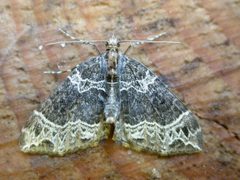
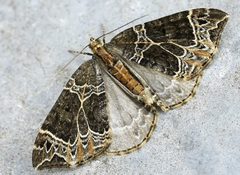
The nearly elliptical white marking in the forewing discal field is a reliable distinguishing feature from similar , though absent in some specimens. Distinguished from Ecliptopera capitata by duller colours, more arrow spots in post-discal region, and brown (not yellow-orange) and . Distinguished from Lampropteryx suffumata by more distinct bowed spots at outer edge that do not extend beyond the wavy line, less jagged transverse lines, and less brown ground colour. Distinguished from Eulithis prunata by less brownish ground colour and less serrated outer transverse line.
Images
Appearance
Wingspan 23–27 mm; forewing length 13–17 mm. Forewings with dark grey basal region bordered by a light band containing dark stains. Broad discal region black-brown, often with a nearly elliptical white marking centrally. Marginal area brown with prominent arrow patches; two or three distally facing peaks continue as orange strokes toward the outer edge. Below apex, dark arch stains and white wavy line at outer edge. Hindwings white-grey with bright crosslines and small black discal spot. , , and brown. Two main colour forms differ in extent of white markings breaking the central forewing band. Male with abdomen tip curled upward when at rest. Larva long and thin, variable green or flesh-colour; thoracic and last four abdominal segments with red or blackish line; middle segments with blackish dots; venter with white line, sometimes pink-edged.
Habitat
Semi-shaded areas in deciduous and mixed forests, young forest plantations, and heaths. Occurs wherever larval foodplants (willowherbs) are present, including varied open and wooded .
Distribution
Europe (including British Isles, north to Arctic Circle, south to Caucasus), east through Russia to Altai and Vyatskoye regions, and parts of North America. Common across Britain and Ireland; absent from Shetland.
Seasonality
Two in most of range: May to July and August to September. Third generation possible in southern parts of range depending on latitude and summer temperatures. season varies geographically.
Diet
Larvae feed primarily on willowherbs (Epilobium spp.).
Host Associations
- Epilobium spp. - larval foodplantwillowherbs
Life Cycle
Usually two annually; sometimes three in favourable conditions. Overwinters as a compact, brownish-green pupa. Larval development on willowherbs; in soil or leaf litter.
Behavior
Male adopts distinctive resting posture with tip curled upward. active in and periods. Two colour forms present in , not seasonally determined.
Human Relevance
Subject of genomic sequencing (Wellcome Sanger Institute, 2024). Monitored in standard recording schemes. No economic significance.
Similar Taxa
- Ecliptopera capitataBrighter colours, fewer arrow spots in post-discal region, yellow to orange-brown and (vs. brown in silaceata)
- Lampropteryx suffumataBowed spots at outer edge more indistinct and extend beyond wavy line; transverse lines more jagged; ground colour more brown
- Eulithis prunataMore brownish ground colour; outer transverse line more serrated
More Details
Genomic resources
Reference sequenced by Wellcome Sanger Institute (2024), available under accession PRJEB64126.
Taxonomic note
Only of Ecliptopera present in Britain and Ireland.