
Lampropteryx suffumata
(Denis & Schiffermüller, 1775)
Water Carpet, Water Carpet Moth
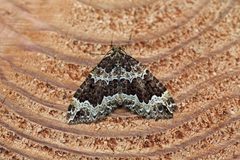
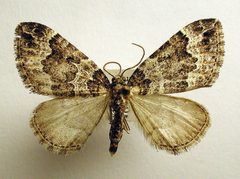
A small to medium-sized geometrid with a wingspan of 25–32 mm, characterized by brownish forewings with distinctive whitish lateral bands and a serrated dark midfield. The has a remarkably broad distribution spanning the entire Holarctic, from Ireland across Eurasia to Alaska and western Canada. are active in spring, with larvae feeding exclusively on Galium species. The species overwinters as a pupa in a silken cocoon spun among the plant.
Pronunciation
How to pronounce Lampropteryx suffumata: /læmˈprɒptərɪks sʌfjuˈmeɪtə/
These audio files are automatically generated. While they are not always 100% accurate, they are a good starting point.
Identification
Distinguished from the similar Devon carpet (Lampropteryx otregiata) by : L. suffumata flies in a single March–June, while L. otregiata has two generations (May–June and August–September). L. suffumata also has a more northerly distribution. The protruding double wave on the outer cross-line and the obscured margin field below the apex are key wing pattern features.
Images
Appearance
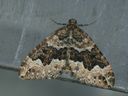
Wingspan 25–32 mm. Forewings brownish with two whitish lateral bands: one between wingbase and midfield, another between central and margin field. Dark midfield serrated on both sides; outer cross-line shows a clearly protruding double wave. Margin field heavily obscured below apex. Hindwings pale grey with strongly curved dark cross-line. Larvae brown with reddish-brown to black-brown angled spots on dorsum; rear segments lighter brown.
Habitat
Damp woodland, grassy areas, chalk downland, scrubland, moorland, and fens. Associated with moist conditions and presence of Galium plants.
Distribution
Holarctic: Ireland, Britain, Scandinavia, central and northern Europe, Altai Mountains, Khabarovsk Krai, Kamchatka Peninsula (Russia), Hokkaido (Japan), Alaska (USA), and Alberta (Canada).
Seasonality
in March to June in one (northern Europe). Larvae present May and June.
Diet
Larvae feed on Galium (bedstraws), including Galium aparine (cleavers).
Life Cycle
stage not described in sources. Larvae feed on Galium in May–June. Pupates in substantial silken cocoon spun among foodplant; overwinters in pupal stage. emerge March–June. In Britain and Ireland, timing has shifted earlier since the 1970s.
Behavior
Rests with wings flat against the surface in a delta shape. activity.
Human Relevance
Subject of genomic study through Darwin Tree of Life project; assembly of 581.6 Mb published. Of interest to lepidopterists due to its broad Holarctic distribution and recent range extension to North America.
Similar Taxa
- Lampropteryx otregiata (Devon carpet)Similar wing pattern and larval plants, but distinguished by period (May–June and August–September), in leaf litter rather than cocoon on host plant, and more southerly distribution.
More Details
Etymology
name from Greek lampros (bright) and pteryx (wing), referring to strong gloss on forewings. suffumata from Latin sub (somewhat) and fumatus (smoky), possibly referencing the obscured, smoky appearance of the wings.
Subspecies
L. s. suffumata (nominate), L. s. arctica (described by Sparre-Schneider, 1890)
Genomic data
assembly: 581.6 Mb, scaffolded into 31 chromosomal pseudomolecules including Z . Mitochondrial genome: 16.48 kb. Protein-coding genes: 18,663.