
Melanchroia chephise
(Stoll, 1782)
white-tipped black, snowbush spanworm
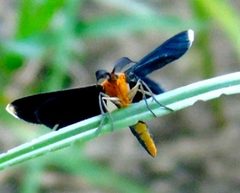
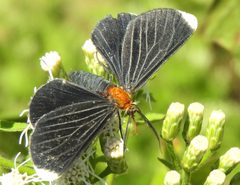
Melanchroia chephise is a in the Geometridae, commonly known as the white-tipped black or snowbush spanworm. It ranges from the southern United States through Central America to Paraguay. The exhibits striking black wings with white patches, while the gregarious larvae feed on foliage of plants in the Phyllanthaceae family, particularly Breynia and Phyllanthus . Despite occasional that defoliate ornamental plantings, the species typically causes no lasting harm to and poses no risk to humans.
Pronunciation
How to pronounce Melanchroia chephise: //ˌmɛlənˈkrɔɪə ˈkɛfaɪsə//
These audio files are automatically generated. While they are not always 100% accurate, they are a good starting point.
Identification
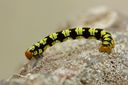
are distinguished by black wings with distinct white patches at the wingtips, giving the its . The wingspan is approximately 33 mm. Larvae are colorful and gregarious, often found in dense groups on foliage. The species was historically confused with ctenuchid due to similar -mimicking coloration and body form, but belongs to Geometridae.
Images
Habitat
Associated with ornamental plantings, particularly snowbush and related Phyllanthaceae. frequent gardens and areas where larval plants occur.
Distribution
Native range extends from Florida and Texas south through Central America to Paraguay. Strays have been recorded from Arizona, Oklahoma, Arkansas, Kansas, and Illinois.
Seasonality
are on wing from September to December in the northern part of the range.
Diet
Larvae feed on foliage of Phyllanthaceae, specifically Breynia disticha and Phyllanthus niruri.
Host Associations
- Breynia disticha - larval ornamental snowbush
- Phyllanthus niruri - larval
Life Cycle
hatch into gregarious caterpillars that feed en masse on foliage. Larvae develop through instars before pupating. emerge and are active during late summer through early winter in northern .
Behavior
Larvae exhibit gregarious feeding , emerging en masse and consuming foliage in groups. are and visit flowers. The has been suggested to employ aposematic coloration, and adults in Texas may mimic the Red-bordered Pixie (Melanis pixe).
Ecological Role
function as . Larvae serve as occasional defoliators of ornamental plants but rarely cause significant ecological impact.
Human Relevance
Occasional pest of ornamental snowbush and related landscape plants. Larval can cause temporary defoliation but plants typically recover without lasting damage. are considered attractive and beneficial in gardens.
Similar Taxa
- Ctenuchinae (subfamily Arctiidae)Similar black and red coloration, narrow wings with light patches, and -mimicking appearance historically caused misidentification; distinguished by -level characters of Geometridae including wing venation and genitalia
- Melanis pixeSuggested mimicry model in Texas; with similar aposematic coloration but different wing shape and pattern
Misconceptions
Despite colorful larval appearance, the poses no risk to humans. Defoliation by larvae is typically temporary and does not cause lasting harm to established plants.
Sources and further reading
- BugGuide
- Wikipedia
- GBIF taxonomy match
- iNaturalist taxon
- NCBI Taxonomy
- Catalogue of Life
- Lepidoptera | Beetles In The Bush | Page 10
- warning coloration | Beetles In The Bush | Page 2
- Florida | Beetles In The Bush | Page 5
- Snowbush spanworm (larva), white-tipped black (adult), Melanchroia chephise (Stoll) (Insecta: Lepidoptera; Geometridae: Melanchroia)