
Melanchroia
Hübner, [1819]
white-tipped black moths, snowbush spanworms
Species Guides
1- Melanchroia chephise(white-tipped black)
Melanchroia is a of in the Geometridae, Ennominae. The genus was established by Jakob Hübner in 1819 and contains eight described distributed from the southeastern United States through the Neotropics to Argentina. are notable for their striking black and white or black and red coloration, often mistaken for tiger moths or -mimicking groups. The best-known species, M. chephise (white-tipped black or snowbush spanworm), is an occasional pest of ornamental plants whose gregarious larvae feed on Euphorbiaceae.
Pronunciation
How to pronounce Melanchroia: /mɛ.lænˈkroɪ.ə/
These audio files are automatically generated. While they are not always 100% accurate, they are a good starting point.
Identification
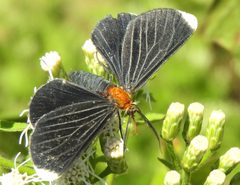
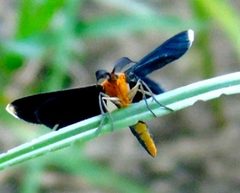
Distinguished from superficially similar tiger moths (/Erebidae: Arctiinae) and -mimicking Ctenuchidae by wing venation and resting posture. Geometrid moths typically hold wings flat and have reduced or non-functional mouthparts in . M. chephise specifically can be distinguished from other Melanchroia by its white-tipped black wing pattern. The is sometimes mistaken for the unrelated wasp groups due to convergent aposematic coloration.
Images
Appearance
exhibit bold aposematic coloration: predominantly black wings with contrasting white or red markings. M. chephise has black wings with white patches and white-tipped margins. Body is slender with narrow wings held flat at rest. Adults are and active during daylight hours. Larvae are colorful caterpillars with gregarious habits.
Habitat
occur in open, sunny including coastal scrub, gardens, and forest edges. Larvae are found on plants in ornamental settings and natural areas. The shows affinity for disturbed and edge habitats where host plants in Euphorbiaceae occur.
Distribution
Southeastern United States (Florida, Texas coastal plains) through Mexico, Central America, and South America to Argentina. Northern distributional limits in the United States are Florida and Texas, with occasional strays further north.
Seasonality
active year-round in tropical portions of range; in the southeastern United States, activity peaks during warmer months. Specific varies by and locality.
Diet
Larvae feed on foliage of plants in the Euphorbiaceae. M. chephise larvae have been documented on Breynia disticha, Phyllanthus niruri, and snowbush (Breynia nivosa). mouthparts are reduced; feeding habits of adults are not well documented but they may visit flowers for nectar.
Host Associations
- Breynia disticha - larval Documented in Venezuela
- Breynia nivosa - larval Snowbush, common ornamental
- Phyllanthus niruri - larval Documented in Venezuela
Life Cycle
Complete with , larva, pupa, and stages. Larvae are gregarious caterpillars that emerge en masse and feed on plant foliage. occurs in soil or leaf litter. Adults are and short-lived. Specific developmental times and voltinism are not well documented.
Behavior
are and active during daylight, unusual for geometrid moths. Larvae are gregarious and feed in groups, sometimes causing noticeable defoliation. Both life stages exhibit aposematic coloration suggesting chemical defense. Adults may be involved in mimicry complexes with other aposematic insects.
Ecological Role
Larvae function as herbivores on Euphorbiaceae, occasionally reaching pest status on ornamental plants. may serve as when visiting flowers. The participates in aposematic mimicry complexes, potentially contributing to education about unpalatable prey.
Human Relevance
M. chephise is an occasional pest of ornamental snowbush and other landscape plants, though damage is usually temporary and not severe. The distinctive appearance of larvae can alarm homeowners despite their minimal risk. are sometimes appreciated in gardens for their striking appearance. The has no significant economic importance otherwise.
Similar Taxa
- Syntomeida epilais (Oleander Moth)Similar black and red/white aposematic coloration and habits; belongs to Erebidae: Arctiinae, not Geometridae
- Ctenuchinae (tiger moth subfamily)Convergent -mimicking appearance; historically confused with Melanchroia due to similar color patterns and activity
- Melanis pixe (Red-bordered Pixie)Suggested as a potential mimicry model for M. chephise in Texas; a with similar coloration
Misconceptions
Frequently misidentified as tiger moths ( Erebidae/) or members of the former family Ctenuchidae due to convergent aposematic coloration and habits. The is actually in Geometridae, a family mostly composed of with cryptic coloration. Larvae are sometimes mistakenly perceived as dangerous due to bright coloration, but they pose no risk to humans.
More Details
Chemical ecology
plants in Euphorbiaceae produce diverse toxins including diterpene esters, alkaloids, glycosides, and ricin-type proteins. Larvae likely sequester these compounds, contributing to aposematic defense. This has been inferred from host plant chemistry but not directly demonstrated in Melanchroia.
Taxonomic history
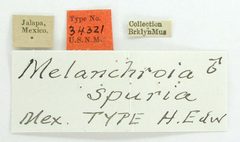
The was established by Hübner in 1819 and has remained stable in Geometridae despite repeated confusion with unrelated aposematic groups. Eight are currently recognized: M. aterea, M. carbonaria, M. chephise, M. geometroides, M. regnatrix, M. tepens, M. vazquezae, and M. venata.
Sources and further reading
- BugGuide
- Wikipedia
- GBIF taxonomy match
- iNaturalist taxon
- NCBI Taxonomy
- Catalogue of Life
- Lepidoptera | Beetles In The Bush | Page 10
- warning coloration | Beetles In The Bush | Page 2
- Florida | Beetles In The Bush | Page 5
- Snowbush spanworm (larva), white-tipped black (adult), Melanchroia chephise (Stoll) (Insecta: Lepidoptera; Geometridae: Melanchroia)