
Melanis pixe
(Boisduval, 1836)
Red-bordered Pixie
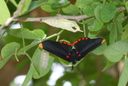
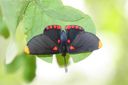
Melanis pixe, commonly known as the red-bordered pixie, is a in the Riodinidae. The was described by Jean Baptiste Boisduval in 1836. It is recognized for its distinctive aposematic coloration featuring black wings with red and yellow-orange markings. The species serves as a Müllerian mimicry model for other toxic insects in its range, including the White-tipped Black (Melanchroia chephise).
Pronunciation
How to pronounce Melanis pixe: //mɛˈlæ.nɪs ˈpɪk.sɛ//
These audio files are automatically generated. While they are not always 100% accurate, they are a good starting point.
Identification
Distinguished from similar Riodinidae by the specific pattern of red and yellow-orange markings on black wings. The combination of yellow-orange forewing tip with red basal spot and red hindwing marginal band is diagnostic. The serves as a model for Müllerian mimicry with Melanchroia chephise in areas of sympatry.
Images
Appearance
Wingspan approximately 40 mm. Upperside of wings black. Forewing with yellow-orange tip and red spot at base. Hindwing with band of red spots along outer margin. laid in clusters of 10–30 on plant leaves, stems, or bark.
Habitat
Associated with trees including Albizia caribea, Inga , and Pithecellobium species. specifics beyond host plant association are not well documented.
Distribution
Lower Rio Grande Valley of South Texas south to Rica. Two recognized: M. p. pixe (Mexico) and M. p. sanguinea (Costa Rica–Panama).
Diet
Larvae feed on leaves of Albizia caribea, Inga , and Pithecellobium species (including P. dulce). feeding habits are not documented.
Host Associations
- Albizia caribea - larval larvae feed on leaves
- Inga - larval larvae feed on leaves
- Pithecellobium dulce - larval larvae feed on leaves
Life Cycle
laid in groups of 10–30 on tree leaves, stems, or bark. Larvae feed on leaves. details are not documented.
Behavior
deposited in clusters on multiple plant surfaces (leaves, stems, bark). The is presumed to be unpalatable to based on its aposematic coloration and its role as a Müllerian mimicry model.
Ecological Role
Serves as a Müllerian mimicry model for the White-tipped Black (Melanchroia chephise) in areas where their ranges overlap. This relationship suggests the possesses chemical defenses that make it unpalatable to .
Human Relevance
Subject of ecological interest due to its mimicry relationships. No significant documented economic or cultural importance.
Similar Taxa
- Melanchroia chephiseWhite-tipped Black exhibits Batesian or Müllerian mimicry of M. pixe; both share black wings with red markings, though M. chephise has white-tipped wings rather than yellow-orange tips
More Details
Mimicry relationships
NABA South Texas notes that Melanchroia chephise are probably mimics of Melanis pixe. Both are aposematic and reach their northern distributional limits in south Texas. The relationship appears to be Müllerian rather than Batesian, as both species are likely chemically defended.
Taxonomic history
Originally described as Limnas pixe by Boisduval in 1836, later transferred to Melanis.
Sources and further reading
- BugGuide
- Wikipedia
- iNaturalist taxon
- NCBI Taxonomy
- Lepidoptera | Beetles In The Bush | Page 10
- Harlequin Bug Coloration Influenced by Temperature During Nymphal Stages
- A new species of black endemic iguanas in Caribbeans is proposed for urgent conservation | Blog
- Nanopublications tailored to biodiversity data
- #How it works: Nanopublications linked to articles in RIO Journal