
Lomographa
Hübner, [1825]
Species Guides
4- Lomographa elsinora
- Lomographa glomeraria(Gray Spring Moth)
- Lomographa semiclarata(Bluish Spring Moth)
- Lomographa vestaliata(White Spring Moth)
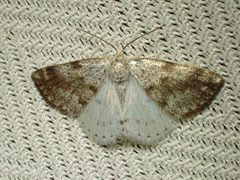
Lomographa is a of geometrid moths in the tribe Baptini, erected by Jacob Hübner in 1825. The genus contains multiple distributed across the Palearctic region, with some extending into North America. The best-studied species is Lomographa bimaculata (White-pinion Spotted), which has served as a model for genomic studies. are generally small with white or pale wings and distinctive dark markings.

Pronunciation
How to pronounce Lomographa: /loʊˈmɒɡrəfə/
These audio files are automatically generated. While they are not always 100% accurate, they are a good starting point.
Identification
Members of Lomographa are small geometrid moths with white or pale wings marked by dark spots or patterns. Lomographa bimaculata specifically shows two black inverted triangular costal spots on the forewings. Accurate identification to level requires examination of genitalia or molecular markers.
Images
Habitat
occur in woodland and open areas with Rosaceae shrubs. Lomographa bimaculata is associated with woodland edges and hedgerows containing hawthorn and blackthorn.
Distribution
Recorded from Europe (including Denmark, Norway, Sweden), extending eastward through Russia and Central Asia to Japan. Present in the British Isles, though local in southern Scotland and Ireland. Absent from southern Spain and northern Scandinavia. North American records include Vermont, USA.
Seasonality
of Lomographa bimaculata fly from mid-April to mid-July in the UK, with peak activity in early June. Seasonality for other in the is not well documented.
Diet
Larvae of Lomographa bimaculata feed on hawthorn (Crataegus sp.), blackthorn (Prunus spinosa), and other Rosaceae shrubs. Dietary habits for other Lomographa are insufficiently documented.
Host Associations
- Crataegus sp. - larval foodplanthawthorn
- Prunus spinosa - larval foodplantblackthorn
- Rosaceae shrubs - larval foodplantgeneral
Life Cycle
Lomographa bimaculata undergoes complete with , larval, pupal, and stages. Caterpillars are greenish with a purplish-red line, with color varying from light yellow to dark red through instars. Adult wingspan ranges 22–26 mm. details for other are not well documented.
Behavior
are . Lomographa bimaculata has shown a slight northward range expansion in the UK with approximately 1% increase over 35 years, though abundance declined 23% from 1970 to 2016.
Human Relevance
Lomographa bimaculata was selected for whole- sequencing, producing a 554.7 Mb assembly with 12,749 protein-coding genes annotated. This genomic resource supports studies of lepidopteran evolution and genetics.
Similar Taxa
- Therini (tribe)Sister tribe to Baptini; members share similar white-winged appearance but differ in genitalia and molecular
- Other Baptini generaSimilar small white geometrid moths; require genital dissection or for reliable separation
More Details
Genomic resources
Lomographa bimaculata assembly comprises 554.7 Mb across 31 chromosomal pseudomolecules (30 + Z ), with a 16.66 kb mitochondrial genome. This represents one of the more complete geometrid genome references available.
Taxonomic placement
Molecular places Lomographa in tribe Baptini within Geometridae Ennominae, with Therini as the closest related tribe.
Data limitations
Most biological information available pertains specifically to Lomographa bimaculata. -level generalizations for appearance, diet, , and are not supported by available sources.