
Euchlaena deplanaria
(Walker, [1863])
Deep Yellow Euchlaena Moth
Euchlaena deplanaria is a of geometrid native to eastern and central North America. have a wingspan of approximately 34 mm and are active from February through October, indicating a broad season. The species is attracted to artificial light sources and has been documented in diverse from deciduous forests to mixed conifer woodlands. It belongs to the Euchlaena, which includes several similarly patterned species that can be challenging to distinguish without close examination.
Pronunciation
How to pronounce Euchlaena deplanaria: //juːˈkleɪnə dɛpləˈnɛɹiə//
These audio files are automatically generated. While they are not always 100% accurate, they are a good starting point.
Images
Appearance
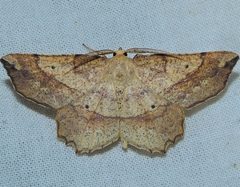
have a wingspan of about 34 mm. The forewings are broad and somewhat triangular, with a deep yellow to orange-yellow ground color. Dark brown to blackish markings typically include a distinct postmedian line and often a discal spot. The hindwings are paler yellow with reduced patterning. The body is relatively stout for a geometrid, with yellowish and . are .
Distribution
Eastern and central North America. Recorded from Colorado eastward to Massachusetts, and south to Florida and Texas.
Seasonality
are on wing from February to October, with peak activity likely varying by latitude.
Behavior
are and attracted to artificial light sources, including porch lights and blacklights. Has been observed at light stations in both lowland and montane settings.
Similar Taxa
- Euchlaena amoenariaSimilar deep yellow coloration and pattern, but amoenaria typically shows more extensive dark shading on the forewings and has a more northern distribution.
- Euchlaena irrariaOverlaps in range and general appearance; separation often requires examination of genitalia or detailed wing pattern analysis.