
Scythris sinensis
(Felder & Rogenhofer, 1875)
Scythris sinensis is a small in the Scythrididae, described by Felder & Rogenhofer in 1875. Native to eastern Asia, it has established across Europe and North America, often associated with human activity. The is thermophilous and , with larvae that mine the leaves of goosefoot plants. are generally , with a possible third partial in warmer southern regions.
Pronunciation
How to pronounce Scythris sinensis: /ˈsɪθrɪs saɪˈnɛn.sɪs/
These audio files are automatically generated. While they are not always 100% accurate, they are a good starting point.
Identification
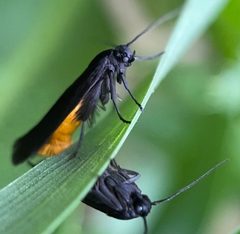
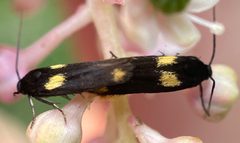
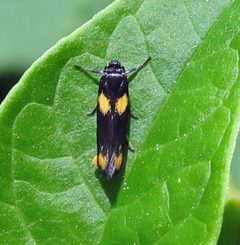
Distinguished from similar Scythris by combination of small size (10–14 mm wingspan), blue-blackish forewings, and dark fuscous hindwings. Second and third show distinctive yellow forewing patches. In Europe, may be confused with other small scythridids; dissection or genitalia examination often required for certain identification. Gregarious early-instar larvae in loose leaf webs on Chenopodium album provide a field clue.
Images
Habitat
Warm, environments including urban city centers, building walls, and flower beds with stone or concrete surfacing. Closely tied to presence of plant Chenopodium album in disturbed, nutrient-rich soils.
Distribution
Native range: eastern Asia (Japan, China, Korea, Taiwan). Established in Europe: Germany, Hungary, Poland (first recorded 2011, Wrocław), Estonia, Latvia, Lithuania, Great Britain (two specimens, Kent 1980, accidental import). North America: Pennsylvania, Vermont. Central Russia and southern Siberia.
Seasonality
in Central Europe with periods May–June and June–July; possible third partial in southern, warmer areas. active diurnally; rarely attracted to artificial light. Best collection time June to early July.
Diet
Larvae feed on Chenopodium album (goosefoot, Chenopodiaceae), mining young leaves at the top of the plant within loose silk webbing.
Host Associations
- Chenopodium album - larval plantLarvae bore into leaves and young stems
Life Cycle
stage not described in detail. Larval stage 12–15 days for summer ; early instars gregarious, later instars solitary; feed in loose spinning inside young leaves. Pupal stage 7–10 days for summer generation. Overwinters as pupa in dense white cocoon near plant. Generally , with possible third partial generation in warmer regions.
Behavior
almost flightless, particularly females. activity pattern; collected by day. Rarely comes to artificial light. Larvae construct loose webbing on plant leaves.
Ecological Role
Herbivore specializing on Chenopodium album; may contribute to regulation of this widespread weed in urban and agricultural edge .
Human Relevance
Accidental human-mediated through trade and transport has facilitated range expansion across Europe and North America. In Great Britain, known only from two specimens discovered in a shop in Kent in 1980, likely imported with goods. In Poland, first detected in urban Wrocław city center, suggesting continued spread via human activity.
Similar Taxa
- Scythris potentillellaSimilar small size and preferences; distinguished by plant association (Potentilla vs. Chenopodium) and genitalia
- Scythris knochellaOverlapping distribution in Europe; requires examination of genitalia or larval plant for reliable separation
- Scythris cicadellaSimilar size and appearance; distinguished by plant preferences and subtle wing pattern differences
More Details
Taxonomic history
Originally described as Butalis sinensis by Felder & Rogenhofer in 1875; later transferred to Scythris.
Research gaps
Detailed and oviposition remain poorly documented. genetics of native versus introduced populations not studied.
Sources and further reading
- BugGuide
- Wikipedia
- GBIF taxonomy match
- iNaturalist taxon
- NCBI Taxonomy
- Catalogue of Life
- Decorations on the Christmas tree: Egg cases of the European mantis, Mantis religiosa, Chinese mantis, Tenodera sinensis, and Carolina mantis, Stagmomantis carolina — Bug of the Week
- Surviving winter, Part III: Egg cases of the Praying mantis, Mantis religiosa, Chinese mantis, Tenodera sinensis, and Carolina mantis, Stagmomantis carolina — Bug of the Week
- Decorations on the Christmas tree: Egg cases of the European mantis, Mantis religiosa, Chinese mantis, Tenodera sinensis, and Carolina mantis, Stagmomantis carolina — Bug of the Week
- Death of a stink bug, Part 1: A curious reunion between the Brown Marmorated Stink Bug, Haylomorpha halys, and the Chinese Praying Mantis, Tenodera sinensis — Bug of the Week
- From the Bug of the Week Mailbag: Non-native mantids, the European mantis, Mantis religiosa, and Chinese mantis, Tenodera sinensis, enjoying North American cuisine — Bug of the Week
- To eat a stink bug, part 1 - A curious reunion, Brown marmorated stink bug, Halyomorpha halys , and Chinese praying mantis, Tenodera sinensis
- Scythris sinensis (Felder & Rogenhofer, 1775) - the first record in Poland, and some new regional records of Scythrididae (Lepidoptera)
- The preimaginal stages and bionomics of Scythris sinensis (Felder and Rogenhofer, 1875) (Lepidoptera, Scythrididae), a Borer in Chenopodium album L. (Chenopodiaceae)