
Neoscythris fissirostris
Meyrick, 1928
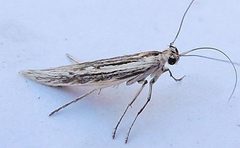
Neoscythris fissirostris is a small in the Scythrididae, described by Edward Meyrick in 1928. It occurs in southwestern and central North America, with records from Arizona, California, Kansas, New Mexico, and Texas. The has a wingspan of 10–15 mm and exhibits distinctive forewing patterning with a white streak. Like other scythridids, it has been observed visiting flowers of composite plants.
Pronunciation
How to pronounce Neoscythris fissirostris: /ˌniːoʊˈsaɪθrɪs ˌfɪsɪˈrɒstrɪs/
These audio files are automatically generated. While they are not always 100% accurate, they are a good starting point.
Identification
Distinguished from similar Scythrididae by the combination of grey forewings with a prominent white streak cut by a fine fold line, dark fuscous spotting at the streak margins, and white costal edge. The specific epithet 'fissirostris' (cleft or split snout) may refer to a subtle structure not readily visible without magnification. Separation from congeneric and the closely related Scythris requires examination of genitalia; Neoscythris species generally lack the strikingly asymmetrical genitalia characteristic of Landryia.
Images
Habitat
Associated with dry, open including clay banks and prairie environments. Has been observed on flowering shrubs in the Asteraceae , particularly Gutierrezia sarothrae (broom snakeweed).
Distribution
Southwestern and south-central North America: recorded from Arizona, California, Kansas, New Mexico, and Texas.
Host Associations
- Gutierrezia sarothrae - visited for nectarobserved on flowers, broom snakeweed
Behavior
are or flower visitors, observed actively moving on composite flowers. Extremely small size and nervous disposition make them difficult to approach and photograph.
Ecological Role
function as or pollen feeders on Asteraceae flowers. Larval unknown; other scythridids include leaf miners on Asteraceae.
Similar Taxa
- Scythris mixaulaabundant in western states, feeds on cactus; distinguished by association and geographic pattern
- Landryia spp.similar size and flower-visiting ; distinguished by asymmetrical genitalia (requires dissection)
- Other Neoscythris species contains numerous undescribed species; reliable identification to level requires examination of genitalia
More Details
Taxonomic history
Originally described as Scythris fissirostris by Meyrick in 1928, later transferred to Neoscythris. placement remains somewhat contentious: treated as family Scythrididae by some authorities (Microleps.org, Photographers Group) or as Scythridinae of Xylorictidae by others (BugGuide.net, Tree of Life).
Research status
The Neoscythris, like many microlepidopteran groups, is poorly revised. Dozens of are known to exist but only 4–6 are formally described per genus. This species may represent part of a larger complex of similar awaiting taxonomic clarification.