
Promalactis
Meyrick, 1908
Species Guides
1- Promalactis suzukiella(Suzuki's promalactis moth)
A of small in the Oecophoridae, established by Edward Meyrick in 1908. The genus comprises approximately 179 valid with highest diversity in China (101 species). Members are characterized by distinctive genitalia and metallic coloration. Larvae have been reported feeding on decaying wood and bark of conifers and other trees.
Pronunciation
How to pronounce Promalactis: /prəʊməˈlæktɪs/
These audio files are automatically generated. While they are not always 100% accurate, they are a good starting point.
Identification
Distinguished from related oecophorid by combination of: smooth metallic-lustrous ; forewings with characteristic markings; male genitalia with variously shaped symmetrical or asymmetrical valvae and narrow to very broad sacculus; female genitalia with developed to ill-defined postvaginalis and elongate thin ductus bursae. Specific identification requires examination of genitalia.
Images
Appearance
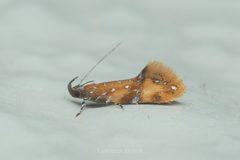
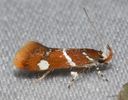
Small with smooth bearing metallic lustre. Forewings with yellow to deep ochreous-brown ground colour, marked with various dark or white patterns. Wing patterns variable among .
Habitat
Forested environments including mixed deciduous forest with Dipterocarpus and Shorea, and dry evergreen forest. Collections reported from elevations 322–1524 m in national parks and protected areas.
Distribution
Primarily Palaearctic and Oriental regions. China has greatest diversity (101 ). Recorded from Japan, Korea, Russia, Vietnam, Thailand, Myanmar, Cambodia, Laos, Indonesia, and USA (Kansas).
Diet
Larvae reported feeding on rotten wood or bark of Pinaceae and other trees. are fungivores and scavengers.
Behavior
; attracted to mercury vapor lamps and black light lamps. Activity patterns poorly documented.
Human Relevance
Subject of taxonomic research due to high ; some documented in citizen science surveys during National Moth Week events.
More Details
Taxonomic diversity
The shows exceptional with 179 valid described, representing one of the most diverse genera in Oecophoridae. Recent taxonomic work has focused on China, Vietnam, and surrounding regions.