
Promalactis suzukiella
(Matsumura, 1931)
Suzuki's promalactis moth
Promalactis suzukiella is a small oecophorid native to East Asia (Korea, Japan, Taiwan) that has become established as an introduced in the eastern United States since the early 2000s. It has undergone rapid range expansion, reaching Texas by 2020. The species is multivoltine with active from March through late September. Larvae develop under the bark of decaying logs of several hardwood trees.
Pronunciation
How to pronounce Promalactis suzukiella: //prəʊməˈlæk.tɪs suːˌzuː.kiːˈɛl.lə//
These audio files are automatically generated. While they are not always 100% accurate, they are a good starting point.
Identification
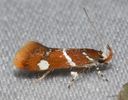
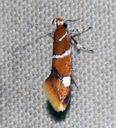
Small size (forewing 4.5–7 mm) and lack of a subbasal band traversing from to margin on the forewing separate this from similar Promalactis species such as P. uniclavata. Male genitalia diagnostic: uncus with thumb-like apex, gnathos tongue-like.
Images
Appearance
Small with forewing length 4.5–7 mm. Forewings lack a subbasal band traversing from to margin (distinguishing it from P. uniclavata).
Habitat
Mixed deciduous forest in mountainous areas; larvae occur under bark of rotting hardwood logs. In introduced North American range, found in suburban and urban areas where attracted to artificial lights.
Distribution
Native to East Asia: Korea, Japan, Taiwan. Introduced to United States: originally recorded from mid-Atlantic states in early 2000s, expanded to Texas and most states east of Mississippi River by 2020, except Florida, northern New England, and Michigan. Also recorded from Laos (2017, single specimen), Vietnam, China, and Russian Far East.
Seasonality
active March through late September in North America, indicating at least two and possibly more per year. In Laos, collected in January (dry season).
Diet
Larvae feed under bark of rotting logs of Prunus virginiana (chokecherry), Quercus (oaks), and Prunus persica (peach). feeding habits unknown.
Host Associations
- Prunus virginiana - larval food sourceunder bark of rotting logs
- Quercus - larval food sourceunder bark of rotting logs
- Prunus persica - larval food sourceunder bark of rotting logs
Life Cycle
Multivoltine with at least two per year based on extended period (March–late September). Larval development occurs under bark of decaying hardwood logs. Specific site and stage not documented.
Behavior
are and attracted to ultraviolet light sources including mercury vapor lamps and black lights. activity spans warm months with multiple overlapping .
Ecological Role
Larvae function as saprophages in decaying hardwood logs, contributing to wood decomposition. Specific impacts in introduced North American range not documented.
Human Relevance
Attracted to porch lights and blacklight traps, making it a frequent observation in citizen science projects such as National Week. No documented economic importance; not known to be a pest of living trees.
Similar Taxa
- Promalactis uniclavataP. suzukiella distinguished by absence of subbasal band traversing from to margin on forewing; male genitalia with uncus having thumb-like apex and tongue-like gnathos versus different genital structure in P. uniclavata
More Details
Taxonomic note
Authorship sometimes cited as Matsumura, 1932; primary sources indicate 1931.
Invasion history
Rapid range expansion in North America suggests strong capability; mechanism of introduction to United States unknown but likely via international trade in wood products.