
Stegasta bosqueella
Chambers, 1875
Red-necked Peanutworm Moth, Rednecked Peanutworm
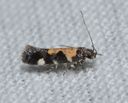
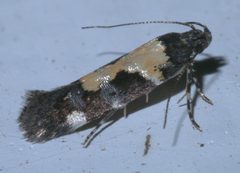
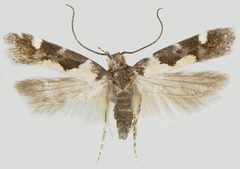
Stegasta bosqueella is a gelechiid whose larvae are significant pests of peanut crops, particularly in South and Central America. The has also been documented in North America from Alabama to Virginia. are small moths attracted to light, while larvae feed concealed within closed peanut leaflets, producing distinctive symmetrical damage patterns upon leaf expansion. The species has been successfully managed using attract-and-kill strategies targeting adults.
Pronunciation
How to pronounce Stegasta bosqueella: /stɛˈɡæstə bɔːˈskwiːlə/
These audio files are automatically generated. While they are not always 100% accurate, they are a good starting point.
Identification
are small gelechiid moths; specific wing patterns are not well documented in available sources. Larvae can be distinguished from the related Stegasta capitella by dark brown coloration of the and , which gives the its . Larval feeding damage is diagnostic: larvae feed within closed peanut leaflets, and when leaves expand they display characteristic symmetrical injury patterns.
Images
Habitat
Agricultural fields, specifically peanut (Arachis hypogaea) . In North America, specimens have been collected in blacklight surveys in residential and semi-rural settings.
Distribution
Native to or established in South and Central America, where it is the main lepidopteran pest of peanuts. In North America, recorded from Alabama, Florida, Georgia, Illinois, Iowa, North Carolina, Oklahoma, South Carolina, Texas, and Virginia.
Diet
Larvae feed on peanut (Arachis hypogaea) foliage, specifically within closed leaflets. do not feed; they are attracted to -food-based attractants used in management programs.
Host Associations
- Arachis hypogaea - primary larvae feed on foliage within closed leaflets
Life Cycle
Complete with , larval, pupal, and stages. Adults lay up to 230 eggs singly or in small groups on peanut plant stems. Larvae pass through five instars while sheltered within closed leaflets. occurs either on the plant or in the soil.
Behavior
Larvae exhibit inconspicuous, concealed feeding , remaining sheltered within closed leaflets throughout development. This cryptic habit makes them difficult to target with foliar . are and attracted to light; they display peak movement between 6 pm and 9 pm. The adult stage is highly mobile and susceptible to attract-and-kill management strategies.
Ecological Role
Agricultural pest . can reduce peanut plant development, affecting production of new shoots, pegs, and pods. The species serves as a target for research involving and microorganisms.
Human Relevance
Significant economic pest of peanut production in South and Central America. Management relies heavily on chemical control, often combined with applications due to peanut variety susceptibility to phytopathogens. Attract-and-kill strategies using -food-based treatments have demonstrated success in reducing damage. Calendar-based applications contribute to overuse and resistance concerns.
Similar Taxa
- Stegasta capitellaAlso a caterpillar pest of peanut plants; distinguished from S. bosqueella by larval and coloration (S. bosqueella has dark brown head and thorax, the basis for its )
More Details
Nomenclatural history
The epithet was long misspelled in the literature as both 'basqueella' and 'bosquella'; the latter incorrect spelling remains more frequently cited than the correct 'bosqueella' (Chambers, 1875).
Management research
levels are not well established, compromising decision-making in programs. Research priorities include developing peanut varieties, refining tactics, and improving understanding of and plant response to injury.
Sources and further reading
- BugGuide
- Wikipedia
- GBIF taxonomy match
- iNaturalist taxon
- NCBI Taxonomy
- Catalogue of Life
- Rednecked Peanutworm: New Guide Examines Management Options for Peanut Pest
- Bug Eric: National Moth Week 2021 Review
- Bug Eric: 2021
- rednecked peanutworm feeding damage - Entomology Today
- rednecked peanutworm adult - Entomology Today
- Stegasta bosqueella Archives - Entomology Today
- Successful management of Stegasta bosqueella (Lepidoptera Gelechiidae) in peanut with an attract‐and‐kill strategy