
Metzneria paucipunctella
(Zeller, 1839)
spotted knapweed seed head moth
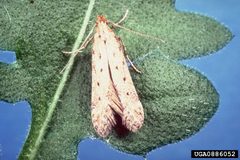
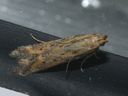
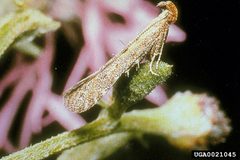
Metzneria paucipunctella is a gelechiid introduced from Europe to North America as a agent against spotted knapweed (Centaurea maculosa). are small, narrow-bodied moths approximately 8 mm long with brownish-gray coloration, light speckling, and large recurved . Females deposit at the base of knapweed flower , where larvae burrow inside to feed on developing seeds and florets. Larvae are small white with dark heads that overwinter within seed heads and pupate the following spring. The has been established across much of the western United States since its introduction in 1980.
Pronunciation
How to pronounce Metzneria paucipunctella: /mɛtsˈnɛriə ˌpɔː.sɪˈpʌŋk.tɛl.lə/
These audio files are automatically generated. While they are not always 100% accurate, they are a good starting point.
Identification
Distinguished from similar gelechiid moths by its association with knapweed flower and its specific ecological role as a seed . may be separated from other Metzneria by genitalia examination; field identification relies heavily on plant association and larval presence within knapweed capitula. Larvae are recognized by their white -like form with dark head capsule found within knapweed seed heads.
Images
Appearance
narrow-bodied, approximately 8 mm in length. Coloration brownish-gray with light speckling. large and recurved. Larva small, plump, white with dark and visible body segmentation.
Habitat
Open, disturbed where spotted knapweed (Centaurea maculosa) occurs, including rangelands, roadsides, and degraded grasslands. The is strictly associated with knapweed flower for larval development.
Distribution
Native to Europe; introduced and established in the western United States including the Pacific Northwest and Rocky Mountain states. Present in the conterminous 48 United States.
Seasonality
active during summer months. Larvae present within seed from in approximately ten days after deposition through period, with occurring the following spring. Peak seed destruction occurs prior to seed in early September, with some larvae continuing to feed into spring.
Diet
Larvae feed on developing seeds and florets of spotted knapweed (Centaurea maculosa). Each larva destroys an average of 8.13 seeds. Larvae web an average of 7.0 seeds together with silk to secure food resources beyond the normal seed period. do not feed.
Host Associations
- Centaurea maculosa - obligate larval Spotted knapweed; sole known for larval feeding and development
- Urophora affinis - competitor/preyIntroduced biocontrol fly; M. paucipunctella larvae cause 19-67% mortality through direct attack and consumption
- Urophora quadrifasciata - competitor/preyIntroduced biocontrol fly; larval mortality occurs but does not increase significantly in spring
Life Cycle
: deposited at base of knapweed flower , approximately 80 per female. Larva: emerges in about ten days, burrows into flower head, feeds on developing seeds and florets, overwinters inside seed head. Pupa: formed within seed head the following spring. : emerges to mate and oviposit. time is with larval stage.
Behavior
Larvae exhibit intraguild , attacking and consuming larvae of other -dwelling biocontrol agents when encountered. Larvae construct silk webbing to bind seeds together, creating a secured food reserve that enables extended feeding beyond the normal seed period. This allows larvae to continue feeding into the spring when seed availability would otherwise be depleted.
Ecological Role
agent contributing to suppression of spotted knapweed through seed . Functions as an intraguild affecting other introduced biocontrol agents, particularly Urophora flies. The increases overall consumer pressure on knapweed seed , though its competitive interactions with other biocontrol agents may complicate management outcomes.
Human Relevance
Intentionally introduced to North America in 1980 as a agent for spotted knapweed, a noxious weed. Now established across much of the western United States. Considered valuable for knapweed management, though best control outcomes occur when used in combination with other biocontrol agents rather than alone. Not known to impact native plants or non-target .
Similar Taxa
- Other Metzneria speciesCongeneric may occur on related Asteraceae; require genitalia dissection for definitive identification
- Urophora affinis and U. quadrifasciataCo-occurring biocontrol agents within knapweed ; these are flies (Diptera) with different larval and do not construct silk webbing
More Details
Biocontrol Introduction History
First introduced to the United States in 1980 for spotted knapweed control. Establishment successful across much of the western United States, though efficacy varies by site and in combination with other agents.
Intraguild Interactions
Cage studies demonstrated that M. paucipunctella larvae cause substantial mortality in Urophora fly larvae, particularly U. affinis, with mortality increasing from 19% during summer-fall to 67% in spring. However, field sampling at 10 sites showed little natural association between and fly attacks on individual seed , suggesting cage conditions artificially concentrated interactions.
Feeding Strategy
The silk-webbing is a notable that distinguishes this from other seed inhabitants. By binding seeds together, larvae create a protected, long-lasting food source that sustains them through winter and into spring when unwebbed seeds would have dispersed or degraded.