
Antaeotricha haesitans
(Walsingham, 1912)
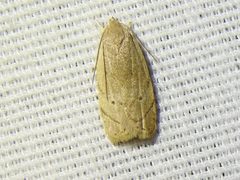
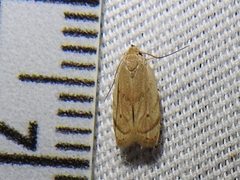
Antaeotricha haesitans is a small in the Depressariidae, first described by Lord Walsingham in 1912. The is characterized by a wingspan of approximately 12 mm and distinctive fawn-ochreous forewings with brown patterning. Its distribution spans parts of Mexico and the southern United States.
Pronunciation
How to pronounce Antaeotricha haesitans: //ˌæn.tiː.əˈtrɪ.kə ˈhaɪ.sɪˌtænz//
These audio files are automatically generated. While they are not always 100% accurate, they are a good starting point.
Identification
Distinguished from similar Antaeotricha by the specific arrangement of brown spots and lines on the forewings: the oblique line from to tornus, three minute and fold spots, and the diffused brown scaling along the dorsum. The combination of pale fawn-ochreous ground color with these specific brown markings is diagnostic. Similar species such as Antaeotricha albulella have different spot patterns, typically with one or two black spots on the forewings.
Images
Appearance
Small with wingspan approximately 12 mm. Forewings pale fawn-ochreous with an oblique fawn-brown line running from the costal cilia to the tornus. Three minute fawn-brown spots present: one at the end of the , one halfway between this and the base, and one in the middle of the fold. A line of brown descends obliquely outward from the plical spot to the dorsum, diffused along it nearly to the tornus. Small brown dots around the apex and termen at the base of the pale fawn cilia. Hindwings fawn-brownish.
Distribution
Mexico (Durango) and United States (Texas).
Diet
Larvae feed on Pithecellobium flexicaule (Texas ebony).
Host Associations
- Pithecellobium flexicaule - larval food plantTexas ebony, a leguminous tree native to the southwestern United States and Mexico
Similar Taxa
- Antaeotricha albulellaSimilar pale-winged appearance, but A. albulella has one or two black spots on forewings rather than three fawn-brown spots, and lacks the oblique line pattern characteristic of A. haesitans
More Details
Taxonomic history
Described by Lord Walsingham in 1912, this has remained relatively obscure with limited subsequent study. The original description was based on specimens from Mexico.