
Antaeotricha floridella
Hayden & Dickel, 2015
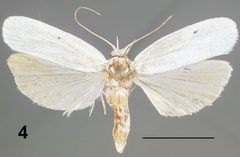
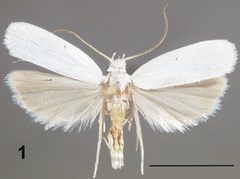
Antaeotricha floridella is a small in the Depressariidae, described in 2015 from peninsular Florida. The is to Florida's sandhills and scrub , where it was initially confused with the similar but more widespread Antaeotricha albulella. Its immaculately white forewings without any spotting distinguish it from close relatives.
Pronunciation
How to pronounce Antaeotricha floridella: /ˌæn.tiː.oʊˈtraɪ.kə ˌflɔːrɪˈdɛlə/
These audio files are automatically generated. While they are not always 100% accurate, they are a good starting point.
Identification
Distinguished from Antaeotricha albulella by the complete absence of black spots on the forewings (A. albulella has one or two black spots) and pale grey hindwings (A. albulella has white or pale-grey hindwings). The snow-white upper surface of the forewings is consistent in A. floridella, whereas close relatives show variable coloration with minute contrasting patterns. A key to pale-winged and their relatives was published alongside the description to facilitate recognition.
Images
Appearance
Forewings matte white with no trace of black discal spots or other maculation; when greased, appear pale lemon yellow. pale brown proximally and white distally. Hindwings pale grey on both sides. Forewing length 6–7 mm in males, 6.5–8.5 mm in females.
Habitat
Dry sandhills and scrub of peninsular Florida. Associated with evergreen sand live oak (Quercus geminata) and other xeric oak vegetation.
Distribution
to peninsular Florida, North America. Recorded exclusively from dry sandhill and scrub areas in the Florida peninsula.
Seasonality
active from April to October.
Diet
Larvae feed on leaves of Quercus geminata (sand live oak), Quercus minima (dwarf live oak), and Galactia regularis. The association with sand live oak is the only confirmed relationship; wider use of oak as hosts remains possible but unverified.
Host Associations
- Quercus geminata - larval sand live oak, evergreen; primary confirmed
- Quercus minima - larval dwarf live oak
- Galactia regularis - larval
Life Cycle
Complete with larval, pupal, and stages. Larvae feed on oak leaves. Specific details of and stages not documented.
Ecological Role
Herbivore as larvae, feeding on oak foliage. Specific ecological functions such as pollination or prey relationships have not been documented.
Human Relevance
Subject of taxonomic research highlighting cryptic diversity in Florida's sandhills. The description helped clarify confusion with the widespread Antaeotricha albulella and contributed to recognition of in Florida's xeric . No known economic or cultural significance.
Similar Taxa
- Antaeotricha albulellaSimilar size and overall appearance, but distinguished by presence of one or two black spots on forewings and white or pale-grey hindwings (versus white forewings and pale grey hindwings in A. floridella). More widespread distribution across eastern North America.
More Details
Discovery and naming
The was brought to scientific attention by Terhune Dickel, who showed specimens to James Hayden of the Florida Department of Agriculture and Consumer Services. Dissection revealed it was distinct from A. albulella. The specific epithet floridella is derived from Florida, reflecting its distribution in that state.
Conservation context
The exemplifies a pattern of unrecognized in Florida's sandhills and scrub. Researchers suggested that additional species currently assigned under incorrect names may await discovery in these , highlighting the need for continued survey of Florida's xeric .