
Psilocorsis quercicella
Clemens, 1860
oak leaftier moth, oak leaf-tying psilocorsis moth
Psilocorsis quercicella is a small in the Depressariidae whose larvae construct leaf shelters by tying oak leaves together. The is known from the eastern and central United States. Larvae skeletonize oak leaves and serve as prey for , including mason wasps in the Ancistrocerus. The moth has been observed to have a of parasitoid species attacking its larval stage.
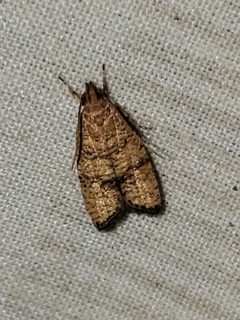
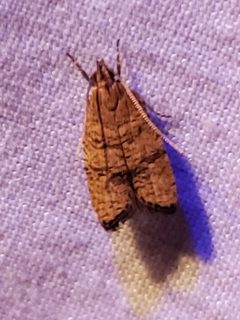
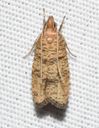
Pronunciation
How to pronounce Psilocorsis quercicella: /ˌsaɪloʊˈkɔrsɪs ˌkwɜrsɪˈsɛlə/
These audio files are automatically generated. While they are not always 100% accurate, they are a good starting point.
Identification
Larvae can be identified by their distinctive leaf-tying on oak, creating shelters from two or more lashed-together leaves. This differs from leaf-rollers, which typically roll single leaves. The Psilocorsis has been placed in different by various authorities (Depressariidae, Amphisbatidae, Oecophoridae), which may cause confusion in older literature. are small and nondescript, making larval signs the more reliable identification method.
Images
Appearance
are small with a wingspan of approximately 14 mm. Specific coloration and pattern details of adults are not well documented in available sources.
Habitat
Associated with oak trees (Quercus ) in forested and woodland . Larvae occur on the leaves of their oaks.
Distribution
United States: recorded from Florida, Maryland, Massachusetts, Oklahoma, and additional records from Manitoba (Canada) and Vermont.
Diet
Larvae feed on Quercus , skeletonizing the leaves of their plant. feeding habits are not documented.
Host Associations
- Quercus - larval plantlarvae skeletonize leaves
Life Cycle
Larvae construct leaf shelters by tying oak leaves together, within which they feed and develop. Specific details of placement, location, and number of per year are not documented in available sources.
Behavior
Larvae exhibit leaf-tying , binding multiple oak leaves together to create a protective shelter. This differs from related that roll single leaves.
Ecological Role
Herbivore that skeletonizes oak leaves. Serves as for a of . Prey for predatory including mason wasps (Ancistrocerus campestris, Ancistrocerus unifasciatus) that hunt the larvae from their leaf shelters.
Similar Taxa
- Leaf-rolling caterpillars (various Tortricidae, Pyralidae, etc.)Similar leaf-shelter construction, but leaf-tiers bind multiple leaves together while rollers use single leaves. Psilocorsis specifically uses oak and creates multi-leaf shelters.
- Ancistrocerus unifasciatus (mason wasp)This preys on leaf-roller caterpillars, not leaf-tiers. The hunting and prey type help distinguish the involved.
More Details
Taxonomic uncertainty
The placement of Psilocorsis has varied across sources: treated as Depressariidae by iNaturalist, GBIF, and Catalogue of Life; as Amphisbatidae in some older literature; and as Oecophoridae in the study abstract. This reflects ongoing taxonomic revision in the Gelechioidea superfamily.
Predation pressure
The has been specifically studied for its , indicating it experiences significant natural enemy pressure. Mason wasps (Ancistrocerus spp.) are documented that actively hunt larvae from their leaf shelters.
Sources and further reading
- BugGuide
- Wikipedia
- GBIF taxonomy match
- iNaturalist taxon
- NCBI Taxonomy
- Catalogue of Life
- Bug Eric: How to (Almost) Catch a Leaf-tier Caterpillar (Video)
- Bug Eric: Wasp Wednesday: Four-toothed Mason Wasp
- Structure and Dynamics of a Parasitoid Community Attacking Larvae ofPsilocorsis quercicella(Lepidoptera: Oecophoridae)