
Depressaria daucella
(Denis & Schiffermüller, 1775)
Dingy Flat-body
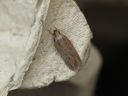
Depressaria daucella is a small in the Depressariidae, commonly known as the Dingy Flat-body. have a wingspan of 21–24 mm and exhibit a distinctive light brown, whitish-sprinkled forewing pattern with dark fuscous dashes. The is notable for its adult activity period, with adults flying from September through winter and again in spring to April. Larvae are leaf miners specializing on umbelliferous plants, particularly Oenanthe species.
Pronunciation
How to pronounce Depressaria daucella: //dɛˌprɛˈsɛɹiə ˌdaʊˈsɛlə//
These audio files are automatically generated. While they are not always 100% accurate, they are a good starting point.
Identification
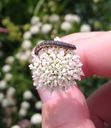
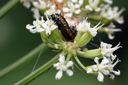
The combination of small size (21–24 mm wingspan), light brown forewings with whitish sprinkling and dark fuscous dashes, and the distinctive two blackish bands on the terminal joint of the labial palpi distinguishes this . The acutely angulated pale fascia at 3/4 on the forewing and the specific wing venation ( 5 connate with stalk of 3 and 4) provide additional diagnostic characters. The larval coloration—dark bluish-grey with orange-yellow lateral line and black white-circled spots—is distinctive among Depressariidae leaf miners on umbellifers.
Images
Habitat
Associated with wetland and waterside where plants grow. Larval habitat is the leaves of umbelliferous plants in moist or aquatic environments.
Distribution
Most of Europe, excluding most of the Balkan Peninsula. Present in North America.
Seasonality
active from September, , and active again to April. Larvae present from June to end of July.
Diet
Larvae are leaf miners feeding on Sison amomum, Carum verticillatum, Cicuta virosa, Oenanthe aquatica, Oenanthe crocata, Oenanthe fistulosa, and Oenanthe pimpinelloides. diet not documented.
Host Associations
- Sison amomum - larval
- Carum verticillatum - larval
- Cicuta virosa - larval
- Oenanthe aquatica - larval
- Oenanthe crocata - larval
- Oenanthe fistulosa - larval
- Oenanthe pimpinelloides - larval
Life Cycle
Complete . Larvae are leaf miners, feeding internally in leaves of plants from June to end of July. emerge in September, overwinter, and are active again in spring to April.
Behavior
overwinter, indicating cold-hardiness and likely seeking sheltered . Larvae exhibit leaf-mining , feeding between epidermal layers of plant leaves.
Ecological Role
Larval leaf mining activity creates damage to leaves of wetland umbellifers, potentially affecting plant . Specific ecological impacts or relationships not documented.
Human Relevance
No documented economic importance. Occasionally encountered by lepidopterists and naturalists in wetland .
Similar Taxa
- Depressaria apiellaFormerly considered or confused; distinct status now recognized. Differences in genitalia and subtle wing pattern distinctions separate the two.
More Details
Taxonomic Note
GBIF lists this as a synonym of Depressaria apiella, but Catalogue of Life and other sources treat D. daucella as a valid, accepted species. The taxonomic relationship between these requires further clarification.
Common Name Origin
The 'Dingy Flat-body' refers to the 's generally dull coloration and the characteristic flattened resting posture typical of Depressariidae.