
Agonopterix argillacea
(Walsingham, 1881)
Clay-colored Agonopterix Moth
Agonopterix argillacea is a small in the Depressariidae, first described by Walsingham in 1881. It is known from a broad range across North America, from the Pacific coast through the Great Plains to the Atlantic provinces and southeastern United States. The has been documented from 915 iNaturalist observations.
Pronunciation
How to pronounce Agonopterix argillacea: //ˌæɡəˈnɒptərɪks ˌɑːrɡɪˈleɪsiə//
These audio files are automatically generated. While they are not always 100% accurate, they are a good starting point.
Identification
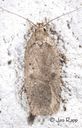
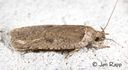
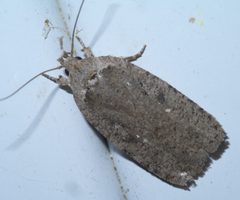
Distinguished from similar Agonopterix by the combination of: pale greyish-ochreous forewing ground color with dense blackish speckling; the specific arrangement of two fuscous dots before the middle followed by a blackish cloud above the middle that reaches a pale whitish dot; and the diffused pale basal patch along the with a sharply defined inner blackish margin. The broad geographic range and association with willow (Salix) and other plants may aid identification where sympatric with .
Images
Habitat
Associated with riparian and wetland supporting larval plants including willows (Salix lasiolepis, S. bebbiana) and other woody vegetation (Amorpha fruticosa, Ptelea trifoliata). Specific habitat preferences for are not well documented.
Distribution
North America: recorded from California to British Columbia on the Pacific coast; eastward through Alberta, Saskatchewan, Manitoba, Ontario, New Brunswick, and Nova Scotia in Canada; and in the United States from Michigan, South Dakota, Illinois, Texas, Florida, Utah, and Vermont. The GBIF distribution records confirm Alberta, Manitoba, Saskatchewan, and Vermont.
Diet
Larvae feed on Salix lasiolepis (arroyo willow), Salix bebbiana (beaked willow), Amorpha fruticosa (false indigo), and Ptelea trifoliata (hop-tree). feeding habits are not documented.
Host Associations
- Salix lasiolepis - larval plantArroyo willow
- Salix bebbiana - larval plantBeaked willow
- Amorpha fruticosa - larval plantFalse indigo
- Ptelea trifoliata - larval plantHop-tree
Ecological Role
Larval herbivore on woody plants in riparian and wetland . Specific ecological functions have not been studied.
Similar Taxa
- Other Agonopterix speciesShare similar size, wing pattern elements (dots, clouds, speckling), and associations. Distinguished by specific arrangement of forewing markings, particularly the pale dirty-whitish dot relative to the blackish cloud, and geographic range.
More Details
Taxonomic history
Originally described as Depressaria argillacea by Walsingham in 1881, later transferred to Agonopterix.
Observation frequency
The has accumulated 915 iNaturalist observations, indicating it is moderately well-documented by citizen scientists.