
Coleophora
Hübner, 1822
Casebearers, Case-bearing moths
Species Guides
60- Coleophora acamtopappi
- Coleophora accordella
- Coleophora argentialbella
- Coleophora asterophagella
- Coleophora atriplicivora
- Coleophora atromarginata(American Pistol Casebearer Moth)
- Coleophora badiipennella(Pale Elm Case-bearer)
- Coleophora benestrigatella
- Coleophora bernoulliella
Coleophora is a large of case-bearing moths in the Coleophoridae, comprising approximately 1,350 described . The genus occurs on all continents but is most diverse in the Nearctic and Palaearctic regions. Larvae construct distinctive portable silken cases from plant material, which serve as key identification characters and provide protection. Many species exhibit narrow host plant specificity, with larvae feeding on seeds, flowers, or leaves.
Pronunciation
How to pronounce Coleophora: /kəˈliːəfəˌrʊ/
These audio files are automatically generated. While they are not always 100% accurate, they are a good starting point.
Identification
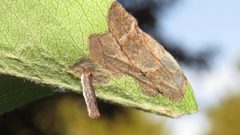
Distinguished from other Coleophoridae by the combination of reduced wing venation (forewing 5 and 8 absent, vein 4 often absent), porrected with rough-scaled basal joint in males, and recurved labial palpi with tufted second joint. Larval cases provide the most reliable identification characters: case shape, size, composition (plant material, sand grains, silk arrangement), coloration, and position on plant vary consistently among . Trivalved hole formed by final instar larva indicates mature case. Species-level identification typically requires examination of genitalia or larval case .
Images
Appearance
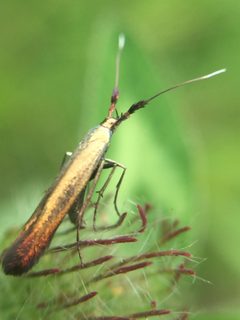
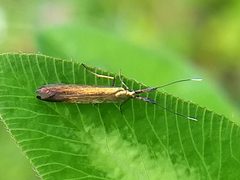
are small with narrow, forewings and linear-lanceolate hindwings approximately two-thirds the width of forewings. four-fifths body length, porrected at rest, often thickened with toward base; males with simple antennae, basal joint long with rough scales or projecting tuft. Labial palpi long, recurved, second joint rough-scaled or tufted beneath, terminal joint shorter and acute. tibiae rough-haired. Forewings with often long-haired beneath; venation reduced with lb furcate, 4 sometimes absent, vein 5 absent, veins 6 and 7 connate or stalked, vein 7 to costa, vein 8 absent. Hindwings with cilia 3-4 times wing width; transverse veins sometimes partly absent, vein 4 usually absent, veins 6 and 7 closely approximated or stalked. Larvae construct -specific portable cases from silk incorporating plant fragments, seeds, or sand grains.
Habitat
vary by and track plant distribution. Documented examples include: saline or loess grasslands for species associated with Kochia; sites where Atriplex oblongifolia occurs; and apple, pear, and plum orchards for pest species. Host plant presence is the primary habitat determinant.
Distribution
All continents. Majority of in Nearctic and Palaearctic regions. Documented country records include: Austria, France, Greece, Hungary, Italy, North Macedonia, Romania, Russia, Slovakia, Switzerland, Ukraine, Canada (Maritime Provinces, Quebec, Ontario), and China.
Seasonality
activity varies by and latitude. Documented examples: Coleophora magyarica adults emerge August–September; Coleophora tyrrhaenica adults late July to early August. Larvae of many species present from autumn (September–October), overwinter in cases, and pupate in mid-summer (July).
Diet
Larvae feed on seeds, flowers, or leaves of plants. Early instars typically mine or feed internally; later instars feed externally while carrying portable cases. Documented host-specific examples: Coleophora magyarica feeds on seeds of Kochia prostrata and Kochia laniflora; Coleophora tyrrhaenica feeds on seeds of Atriplex oblongifolia; Coleophora fletcherella feeds on leaves of Malus (apple), Prunus (plum), and Pyrus (pear).
Host Associations
- Kochia prostrata - larval plantseeds consumed by C. magyarica
- Kochia laniflora - larval plantseeds consumed by C. magyarica
- Atriplex oblongifolia - larval plantseeds consumed by C. tyrrhaenica; first documented record
- Malus spp. - larval plantleaves consumed by C. fletcherella
- Prunus spp. - larval plantleaves consumed by C. fletcherella
- Pyrus spp. - larval plantleaves consumed by C. fletcherella
- Chamaecytisus austriacus - larval plant for C. cytisicolella
Life Cycle
laid on plants. Larvae hatch and initially feed internally on seeds, flowers, or leaves. As larvae grow, they construct portable silken cases incorporating host plant fragments, seeds, or sand grains; cases enlarged or replaced at . Final instar larvae descend to base of host plant or seek sheltered positions (tree bases, soil surface), attach cases, and overwinter. In mid-summer, larvae ascend host plants, fix cases to upper vegetation, pupate within days. emerge in mid-summer to early autumn depending on . Some species produce new cases at each molt.
Behavior
Larvae carry portable cases throughout feeding period, extending and to feed while case remains attached to . Cases serve dual function of physical protection and through mimicry of plant parts or debris. Final instar larvae prepare by constructing trivalved exit hole in case prior to . Larvae of some show seasonal vertical : descending to overwinter at plant base, ascending to pupate on upper vegetation.
Ecological Role
Larvae function as seed and folivores on plants. Narrow host specificity of many suggests potential role in regulating host plant . Discarded larval cases accumulate on host plants, potentially indicating local . Specific functions beyond herbivory not documented in available sources.
Human Relevance
Some are agricultural pests. Coleophora fletcherella (cigar case-bearer of apple) has caused significant damage in apple, pear, and plum orchards in eastern Canada. Larval feeding on leaves and fruit reduces crop quality and yield. No documented beneficial uses or cultural significance.
Similar Taxa
- Other Coleophoridae generaShare -level traits of case-bearing larvae, but distinguished by particularly wing venation and antennal structure
- Psychidae (bagworm moths)Larvae also construct portable cases, but cases are larger, more robust, and typically not incorporated with specific plant fragments in same manner; have different wing venation and body form
More Details
Taxonomic stability
Numerous attempts to subdivide Coleophora into smaller have been proposed but most have not achieved widespread acceptance; the genus remains taxonomically conservative despite its large size.
Identification methodology
Larval case provides critical characters for identification, particularly where specimens are unavailable; this has led to ongoing discoveries of plant associations and case descriptions for previously unknown species.
Molecular resources
has been applied to several with sequences deposited in BOLD System and GenBank, supporting species identification where is ambiguous.
Sources and further reading
- BugGuide
- Wikipedia
- iNaturalist taxon
- NCBI Taxonomy
- Catalogue of Life
- Biology and DNA barcode analysis of Coleophora lessinica Baldizzone, 1980 and Coleophora impalella Toll, 1961 (Lepidoptera, Coleophoridae) with description of their larval cases
- Coleophoridae in the spotlight II. : On some aspects of the biology of Coleophora magyarica Baldizzone, 1983 and Coleophora tyrrhaenica Amsel, 1952 (Lepidoptera: Coleophoridae)
- Figure 29 from: Takács A, Szabóky C, Boldog G, Jordán S, Bozsó M, Fülöp D, Tóth B (2022) Biology and DNA barcode analysis of Coleophora lessinica Baldizzone, 1980 and Coleophora impalella Toll, 1961 (Lepidoptera, Coleophoridae) with description of their larval cases. Nota Lepidopterologica 45: 191-205. https://doi.org/10.3897/nl.45.80106
- Map 1 from: Takács A, Szabóky C, Boldog G, Jordán S, Bozsó M, Fülöp D, Tóth B (2022) Biology and DNA barcode analysis of Coleophora lessinica Baldizzone, 1980 and Coleophora impalella Toll, 1961 (Lepidoptera, Coleophoridae) with description of their larval cases. Nota Lepidopterologica 45: 191-205. https://doi.org/10.3897/nl.45.80106
- Checklist and new species of the Coleophora salicorniae group from China (Lepidoptera: Coleophoridae)
- THE CIGAR CASE-BEARER OF THE APPLE (COLEOPHORA FLETCHERELLA)
- Coleophora cytisicolella sp. nov., a new species (Lepidoptera, Coleophoridae), from Austria and Hungary bred from Chamaecytisus austriacus.