
Blastobasidae
Meyrick, 1894
Blastobasid Moths
Subfamily Guides
1is a of small in the superfamily Gelechioidea, containing approximately 30 and hundreds of distributed worldwide. are generally slender, reddish-brown moths with wingspans of 12–24 mm, lacking conspicuous markings. Larvae feed on dead organic matter, though some species are pests of stored products or cultivated crops. The family's remains unstable, with relationships among genera poorly resolved and various arrangements placing Blastobasidae as a of Coleophoridae or including Symmocidae within it.
Pronunciation
How to pronounce Blastobasidae: /ˌblæstəˈbeɪsɪdiː/
These audio files are automatically generated. While they are not always 100% accurate, they are a good starting point.
Identification
Distinguished from similar gelechioid by combination of: small size (12–24 mm wingspan), slender build, reddish-brown unmarked wings, with specialized hairy base, forewing venation with 12 and complete transverse vein but no tubular vein through , and hindwings with narrow shape and long fringe. Separation from Coleophoridae (case-bearers) and Symmocidae is problematic and varies by taxonomic arrangement; genitalia examination often required for definitive identification. Within family, distinguished by wing venation details (particularly hindwing vein number and arrangement), antennal structure, and genital .
Images
Appearance
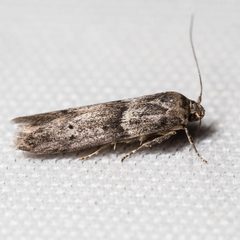
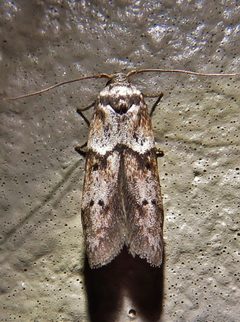
Small to very small with wingspans of 12–24 mm. Body slender, coloration typically reddish-brown without crisp streaks or large wing spots. smooth with moderately long (slightly more than half forewing length), situated halfway down head; antennae , lacking clubs or comb-like structures in males, with base bearing dense brush of hairs and flat with concave underside. with few or no bristles, ocelli absent. Mouthparts well-developed: 4-segmented folding maxillary palps, long labial palps, long with scaly base. Forewings 4–5 times longer than wide, lacking tornus, with convex outer margin and blunt tip; 12 with two anal veins (1b forked proximally, 1c tubular and complete distally), complete transverse vein, without tubular vein through middle. Hindwings narrow, round-tipped, equal or slightly shorter than forewings, joined by ; fringe of hairs about twice wing width; seven or eight veins with anal veins 1b and 1c (1b may fork or not), transverse vein present or absent, usually five veins from (fourth and fifth proximally joined), vein 8 running along or arising from upper cell margin. Foreleg tibiae enlarged at apex; midleg tibiae with two spurs; hindleg tibiae with four spurs and many long thin hairs.
Habitat
Found in diverse terrestrial worldwide; specific habitat associations vary by . Some species occur in agricultural and stored product environments.
Distribution
distribution with recorded from all major biogeographic regions including North America, Central America (e.g., Rica), South America, Europe (e.g., Denmark, Norway, Sweden), Asia (e.g., China, India), and elsewhere. Some introduced by human activity.
Diet
Larvae feed on dead organic matter. Some are pests of stored foodstuffs. Specific feeding records include: Neoblastobasis camelliae on fruits of Camellia oleifera (Theaceae); Syncola crypsimorpha and S. pulverea as of cultured lac insect Kerria lacca (Hemiptera: Kerridae); Blastobasis coffeaella on coffee fruits; Blastobasis graminea as sugar cane stem borer.
Host Associations
- Camellia oleifera - herbivoreFruits consumed by Neoblastobasis camelliae
- Kerria lacca - Syncola crypsimorpha and S. pulverea are of this cultured lac insect
- Coffea - herbivoreBlastobasis coffeaella on coffee fruits
- Saccharum - herbivoreBlastobasis graminea as stem borer in sugar cane
Life Cycle
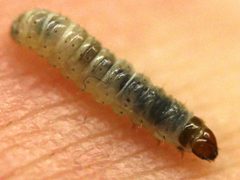
Complete with , larva, pupa, and stages. Larvae have 10 and feed openly. Pupae concealed and not protruded during .
Ecological Role
Larvae function as in many systems, contributing to decomposition of dead organic matter. Some act as of other insects. A subset of species function as agricultural pests.
Human Relevance
Several are economically significant pests: Blastobasis coffeaella damages coffee fruits; Blastobasis graminea bores sugar cane stems; Neoblastobasis camelliae infests Camellia oleifera fruits; Syncola species damage cultured lac production in India by preying on Kerria lacca. Some species infest stored food products.
Similar Taxa
- ColeophoridaeCase-bearer moths; sometimes treated as Blastobasinae within Coleophoridae. Separation based on larval (Coleophoridae larvae construct portable cases) and subtle morphological differences, though boundaries disputed.
- SymmocidaeSometimes included in as or tribe; relationships and rank assignment remain unresolved in Gelechioidea .
More Details
Taxonomic instability
The 's classification remains contentious. Various treatments place as a of Coleophoridae, include Symmocidae within Blastobasidae, or recognize subfamilies Holcocerinae and Blastobasinae. Phylogenetic relationships among the approximately 30 are poorly understood; the large genera Blastobasis and Holcocera are suspected to be non-monophyletic and likely to be subdivided with better data.
Research activity
Recent taxonomic work has substantially expanded known diversity, particularly in understudied regions. The Rican fauna alone added 101 new and 5 new in a single 2013 revision, suggesting global diversity is significantly underestimated.
Sources and further reading
- BugGuide
- Wikipedia
- GBIF taxonomy match
- iNaturalist taxon
- NCBI Taxonomy
- Catalogue of Life
- Review of the Blastobasinae of Costa Rica (Lepidoptera: Gelechioidea: Blastobasidae)
- Status of the phylogenetic-classification of the Blastobasidae (Lepidoptera: Gelechioidea) and insights to the evolution of host-plant preferences within its major clades
- Taxonomic study of the genus Hypatopa Walsingham, 1907 (Lepidoptera: Blastobasidae) in China, with descriptions of five new species
- Camellia fruit borer, <i>Neoblastobasis camelliae</i>, a new species of Blastobasinae in China (Lepidoptera, Blastobasidae)
- Taxonomic study of the genus <I>Lateantenna<D> Amsel, 1968 (Lepidoptera: Blastobasidae) from Mainland China, with descriptions of four new species
- Syncola crypsimorpha (Meyrick, 1922) (Gelechioidea: Blastobasidae): A new pest species associated with cultured lac in India