
Paranthrene simulans
(Grote, 1881)
Hornet Clearwing Moth, Red Oak Clearwing Borer, Oak Clearwing Borer
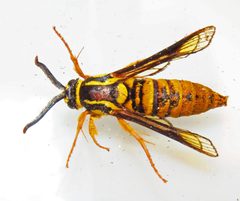
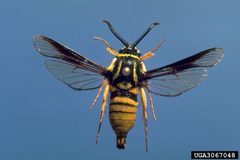
Paranthrene simulans is a clearwing moth in the Sesiidae, known for its striking resemblance to or . are active during daylight hours and are frequently mistaken for hymenopterans due to their transparent wings, wasp-like coloration, and . The is distributed across eastern North America, where larvae develop as borers in oak and other hardwood trees.
Pronunciation
How to pronounce Paranthrene simulans: /pæˈɹænθɹiːn ˈsɪmjʊlænz/
These audio files are automatically generated. While they are not always 100% accurate, they are a good starting point.
Identification
Distinguished from other clearwing moths by the specific pattern of dark scaling on wing borders and body banding. Resembles Paranthrene robiniae (peachtree borer) but differs in association and minor pattern details. Can be separated from actual by the presence of scaled wing bases, clubbed or slightly thickened (not elbowed), and the inability to fold wings longitudinally at rest. Males have more slender and slightly longer antennae than females.
Images
Appearance
exhibit pronounced hymenopteran mimicry with a slender body marked by yellow and black or dark brown bands. Wings are largely transparent with reduced scaling, dark veining, and dark borders. The body is relatively hairless compared to typical . are simple or slightly serrate. Wingspan ranges approximately 25–35 mm. Larvae are creamy white to pale yellow wood-borers with a dark brown and thoracic shield.
Habitat
Associated with deciduous hardwood forests and urban or suburban areas where trees occur. are observed in open, sunny areas near larval hosts. Larval is within the cambium and heartwood of living or recently dead oak trees and occasionally other hardwoods.
Distribution
Eastern North America: Nova Scotia south to Florida, west to Minnesota, Missouri, and Mississippi. Records also indicate presence in adjacent Nearctic regions.
Seasonality
are active primarily during summer months, with peak typically June through August in most of the range. Larvae are present year-round within trees.
Host Associations
- Quercus - larval primary ; larvae bore in living oaks
- hardwood trees - larval occasional records from other deciduous trees
Life Cycle
Complete . are laid on bark of trees. Larvae tunnel into cambium and sapwood, creating galleries that may girdle branches or trunks. Larval development spans one to two years depending on climate and tree condition. occurs in a silken cocoon within the gallery or in wood chips near the gallery entrance. emerge through exit holes and do not feed.
Behavior
are and exhibit rapid, -like that enhances their mimicry. They are known to visit flowers for nectar. When disturbed, they may adopt a wasp-like posture with curled and wings spread. Larvae remain concealed within wood throughout their development.
Ecological Role
As a wood-borer, larvae contribute to nutrient cycling in forest by breaking down hardwood . They may act as secondary invaders in stressed or damaged trees. serve as when visiting flowers. Their mimicry provides protection from vertebrate .
Human Relevance
Occasional pest of ornamental and shade oaks; heavy can weaken or kill branches. Valued by entomologists and naturalists for its remarkable mimicry. Sometimes mistaken for stinging insects, causing unnecessary concern. No direct economic benefit or harm to humans otherwise.
Similar Taxa
- Paranthrene robiniaeSimilar appearance and clearwing ; distinguished by preference (Prunus spp. vs. Quercus) and subtle differences in wing pattern scaling
- Vespula spp.Visual mimic; distinguished by wing structure (scaled vs. membranous), shape, and body segmentation
- Sphecius speciosusAnother visual mimic (cicada killer ); distinguished by larger size, different wing venation, and behavioral differences
More Details
Mimicry type
of hymenopterans, specifically vespid and
Conservation status
Not evaluated; appears secure throughout range based on observation frequency