Synanthedon tipuliformis
(Clerck, 1759)
currant clearwing, currant borer moth, currant clearwing moth
Synanthedon tipuliformis, the currant clearwing, is a clearwing moth native to the that has become in the Nearctic and Australasian realms. are mimics with transparent wings scaled only along and margins. Larvae are internal feeders that bore into the pith of Ribes canes, causing significant damage to currant and gooseberry . The is in temperate regions, with adults emerging in late spring to early summer.
Pronunciation
How to pronounce Synanthedon tipuliformis: /sɪˌnænˈθiːdən ˌtɪpjʊləˈfɔːrmɪs/
These audio files are automatically generated. While they are not always 100% accurate, they are a good starting point.
Identification
Distinguished from similar clearwing moths (Synanthedon spuleri, S. conopiformis, S. cephiformis, S. flaviventris, S. loranthi) by the combination of: yellow thoracic stripes, specific abdominal ring pattern (segment 7 ring present in males only), and the elongated forewing discal spot. Reliable identification requires examination due to minimal external differences among . lures specific to this can aid detection.
Images
Appearance
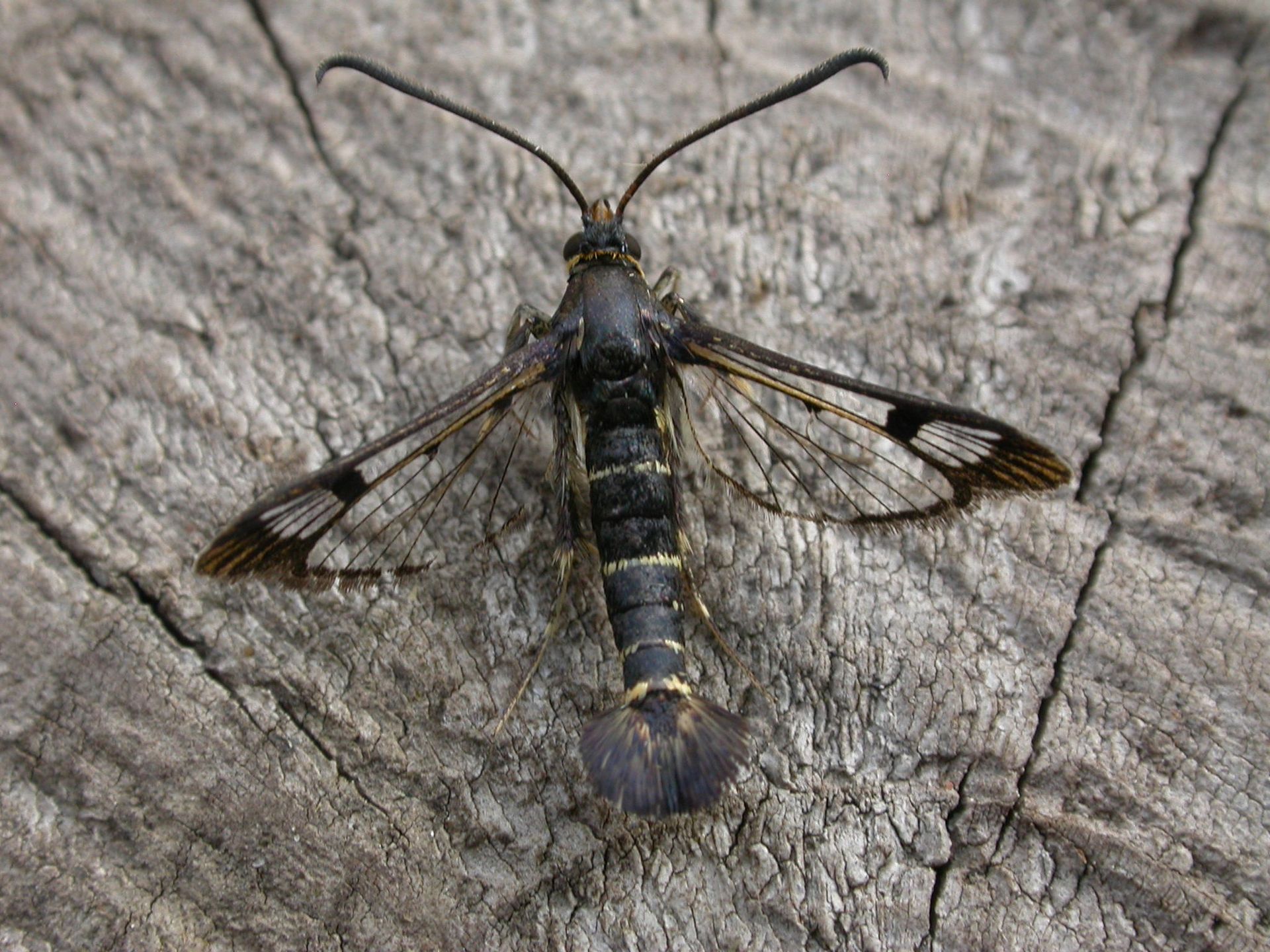
have transparent wings with restricted to , discal spots, and margins, giving a blue-black sheen. Wingspan 17–20 mm. Forewings bear weak reddish or yellowish longitudinal stripes at the apex and an elongated black-brown discal spot extending from front to rear margin. Hindwings have a narrow dark marginal band and small black-brown discal spot. are black with yellow dusting on the underside. is black with lateral yellow stripes. is black with thin yellow rings on segments 2, 4, 6, and 7 in males; segments 2, 4, and 6 in females. Tufts are strongly fan-shaped and blue-black.
Habitat
Found in agricultural and horticultural settings where Ribes are cultivated, including blackcurrant, redcurrant, and gooseberry plantings. Also occurs in wild or Ribes . In invaded regions, established in areas with suitable plants.
Distribution
Native to the (Europe, Asia). in the (North America) and Australasian realm (Australia, New Zealand). Within invaded ranges, distribution follows commercial and wild Ribes plantings.
Seasonality
fly from April to July in the Palearctic, with timing varying by location. In Tasmania, adults emerge November to early January. In New Zealand Canterbury, adults occur mid-November to early January. activity peaks at air temperatures of 20–23°C, with activity ceasing below 15°C. Peak flight occurs on cloudy days.
Diet
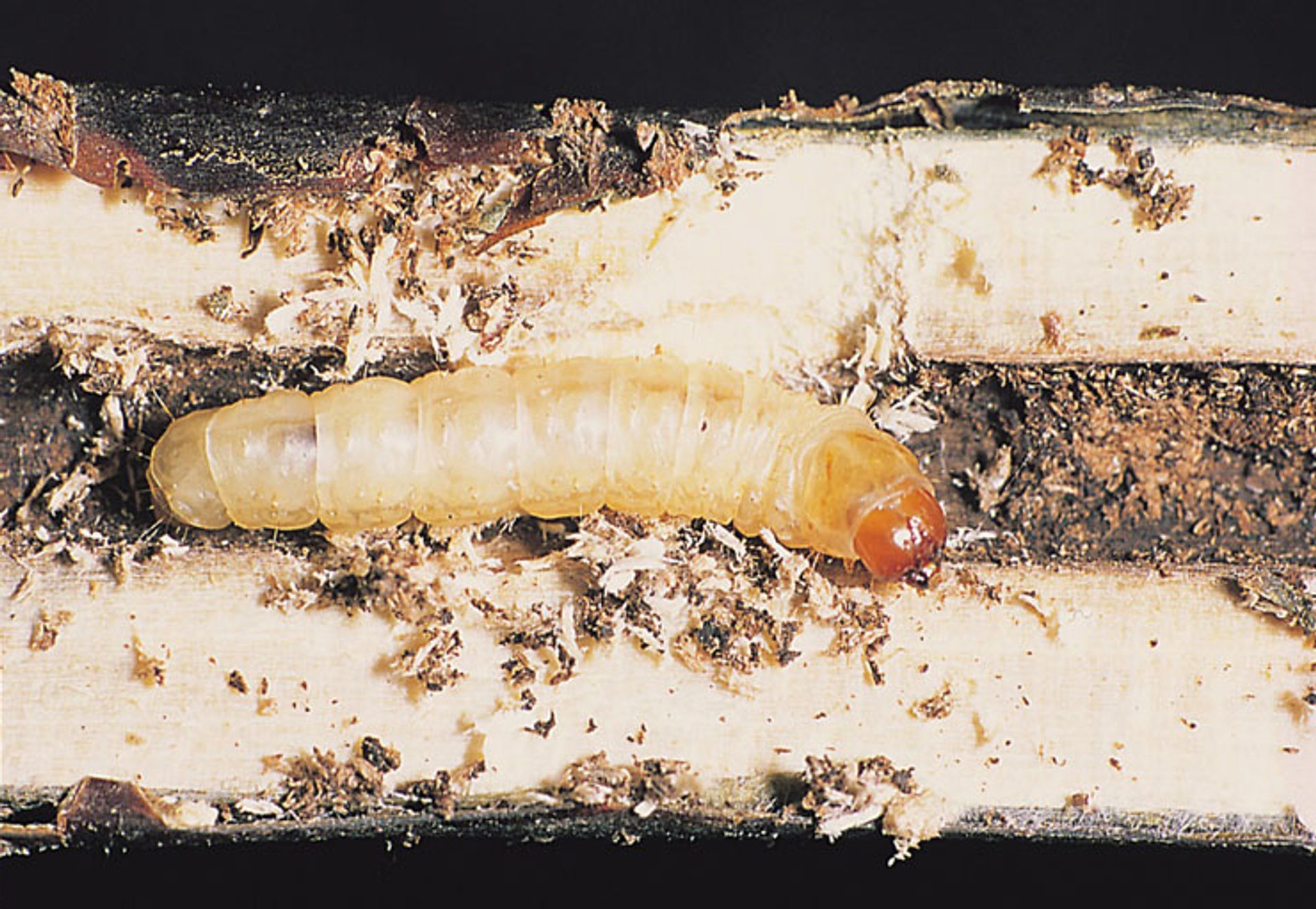
Larvae feed internally on the pith of Ribes canes, including Ribes nigrum (blackcurrant), R. rubrum (redcurrant), and R. uva-crispa (gooseberry). do not feed.
Host Associations
- Ribes nigrum - larval blackcurrant; primary cultivated
- Ribes rubrum - larval redcurrant
- Ribes uva-crispa - larval gooseberry
Life Cycle
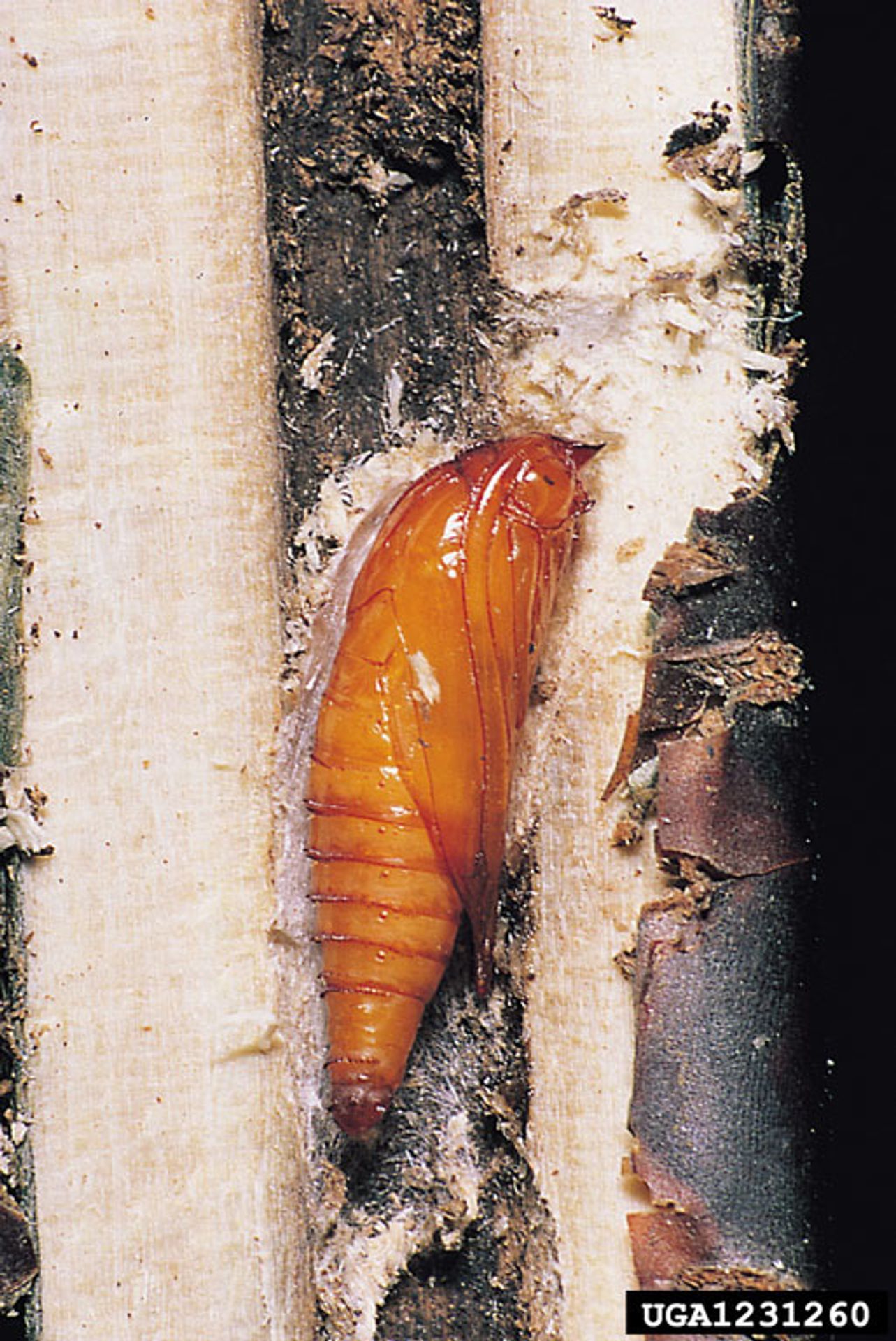
(one per year). laid on canes, often near wounds, buds, or openings; mean approximately 100 eggs per female. Egg incubation averages 19 days. Larvae bore into canes through openings or buds, then feed on pith until late autumn, tunneling mean 15.2 cm of pith. Larvae enter winter and resume feeding in late winter to spring. Six larval instars suggested. occurs in mid-spring to early summer; pupal stage lasts up to 6 weeks. emerge, live approximately 7 days, and do not feed.
Behavior
are and exhibit -mimicry in appearance and . Females display bimodal calling to attract males: peak calling occurs approximately 2 hours before sunset, with secondary activity at sunrise for about 30 minutes and increasing intensity from mid-morning through afternoon. Calling occurs primarily from undersides of leaves. Calling timing and duration are influenced by temperature and light intensity. One- to two-day-old females call most intensively; calling onset shifts earlier by up to 3 hours over successive days, likely enhancing mating probability. Males are attracted to female between 1400–1600 h. Mating lasts over 2 hours. Adults fly rapidly and low near vegetation. Most individuals are not attracted to lights, though occasional captures at blacklights have been reported for some Synanthedon .
Ecological Role
Pest in Ribes , causing economic damage through larval tunneling that weakens canes and reduces yield. In invaded regions, may experience reduced and compared to native range. First record of Cordyceps sp. fungus attacking this species reported from New Zealand.
Human Relevance
Significant agricultural pest of currants and gooseberries worldwide. Larval boring damages canes, reducing plant vigor and fruit production. Management includes pruning of infested wood, monitoring traps, and targeted applications. Pruning of 1- and 2-year-old wood, which harbors most larvae, can reduce . The ' -mimic appearance can cause misidentification by growers and observers.
Similar Taxa
- Synanthedon spuleriSpuler's clearwing; extremely similar external requiring examination for reliable separation
- Synanthedon conopiformisSimilar size and general appearance; distinguished by subtle differences in abdominal pattern and genitalia
- Synanthedon cephiformisFir clearwing; similar transparent-winged appearance but associated with Abies rather than Ribes
- Synanthedon flaviventrisSallow clearwing; similar but associated with Salix and Populus
- Synanthedon loranthiMistletoe clearwing; similar appearance but associated with mistletoe (Loranthaceae)
More Details
Population dynamics
and larval distribution is aggregated, adequately described by negative binomial distribution. Less than 10% of eggs are laid on current season's growth despite this representing over 50% of available substrate; over 80% of pre-pupal larvae occur in the most recent 2 years' growth.
Mortality factors
Key mortality factor is survival. Other significant factors include establishment failure, larval combat, winter pruning, loss of pupae at cane breaks, pupal failure, and limited , , and in invaded ranges.
Thermal requirements
development thermal constant: 91 day degrees. Pupal development thermal constant: 216 day degrees.
Sources and further reading
- BugGuide
- Wikipedia
- GBIF taxonomy match
- iNaturalist taxon
- NCBI Taxonomy
- Catalogue of Life
- Euhagena nebraskae… again | Beetles In The Bush
- Calling behaviour of females of currant clearwing moth, Synanthedon tipuliformis (Clerck) (Lepidoptera, Sesiidae)
- Life tables of currant clearwing, Synanthedon tipuliformis (Lepidoptera: Sesiidae), in blackcurrant in Canterbury
- THE BIOLOGY AND BEHAVIOUR OF CURRANT BORER MOTH, SYNANTHEDON TIPULIFORMIS(CLERCK) (LEPIDOPTERA: AEGERIIDAE) IN TASMANIA
- The biology and life history of currant clearwing, Synanthedon tipuliformis (Lepidoptera: Sesiidae), in Canterbury
- Distribution and Invasion of Clearwing Moth Synanthedon Tipuliformis Cl.,a Pest Of Currant, in Latvia
- The distribution and dispersion of life stages of currant clearwing, Synanthedon tipuliformis (Lepidoptera: Sesiidae), in blackcurrant
- The genome sequence of the Currant Clearwing moth, Synanthedon tipuliformis (Clerck, 1759).