
Synanthedon sapygaeformis
(Walker, 1856)
Florida Oakgall Moth, Florida Oakgall Borer Moth
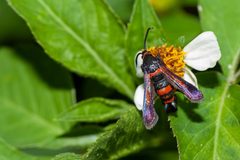
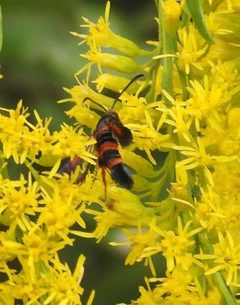
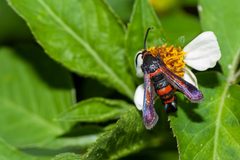
Synanthedon sapygaeformis is a clearwing moth in the Sesiidae, commonly known as the Florida Oakgall or Florida Oakgall Borer Moth. A , S. sapygaeformis floridensis, has been documented in Florida with biological notes published in 1964. As with other sesiids, this exhibits mimicry through its transparent wings and hymenopteran-like appearance. The specific epithet 'sapygaeformis' references a resemblance to wasps in the Sapyga.
Pronunciation
How to pronounce Synanthedon sapygaeformis: //sɪˌnænˈθiːdɒn ˌseɪpɪˈɡeɪ.ɪfɔːrmɪs//
These audio files are automatically generated. While they are not always 100% accurate, they are a good starting point.
Identification
Distinguished from other clearwing moths by association with oak galls and geographic distribution centered in Florida. The S. sapygaeformis floridensis is recognized from Florida . Specific diagnostic features separating it from congeneric such as S. acerni and S. scitula require detailed examination and are not fully documented in available sources.
Images
Appearance
As a clearwing moth, possesses transparent areas on wings due to reduced scaling, with dark borders and . Body typically -like in form, with coloration suggesting hymenopteran mimicry. Specific color pattern details for this are not well documented in available sources.
Habitat
Associated with oak ; specific oak and habitat requirements not detailed in available sources. The floridensis has been documented in Florida field settings.
Distribution
Nearctic region; primarily documented from Florida based on S. sapygaeformis floridensis and . Distribution records in GBIF indicate Nearctic occurrence.
Host Associations
- Quercus - associated with oak galls indicates gall association; specific oak not documented in available sources
Behavior
As with many sesiid , likely in activity pattern. Clearwing moths in this are generally not strongly attracted to light traps, though some Synanthedon have been occasionally recorded at blacklights.
Ecological Role
Larval association with oak galls suggests role in gall-inhabiting ; specific ecological function not documented.
Human Relevance
suggests potential minor significance as a borer in oak; no major economic or ecological impact documented in available sources.
Similar Taxa
- Synanthedon acerniCongeneric clearwing moth; both in same with similar -mimicking appearance, but S. acerni has been documented at blacklights while attraction patterns for S. sapygaeformis are less known
- Synanthedon scitulaCongeneric clearwing moth with documented blacklight attraction; differs in associations and geographic distribution
- Synanthedon fatiferaCongeneric clearwing moth known to bore into Viburnum crowns; differs in plant and likely geographic range
More Details
Subspecies
A , Synanthedon sapygaeformis floridensis (Grote), was described and its noted in a 1964 Florida Entomologist paper. The nominate subspecies may occur elsewhere in the range.
Etymology
The specific epithet 'sapygaeformis' derives from Sapyga (a of sapygid ) + Latin 'formis' (shaped), indicating the ' wasp-like appearance.