
Synanthedon proxima
(Edwards, 1881)
dogwood borer
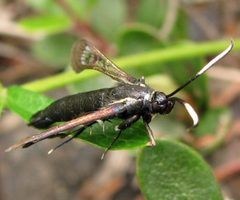
Synanthedon proxima, commonly known as the dogwood borer, is a clearwing moth in the Sesiidae. It is native to North America and primarily associated with Cornus . The species is recognized as a significant pest of ornamental dogwoods, particularly in urban and suburban landscapes. exhibit -mimicking appearance typical of the family, with transparent wings and often yellow or orange coloration. Larval stages bore into the stems and trunks of plants, causing structural damage.
Pronunciation
How to pronounce Synanthedon proxima: /sɪˈnænθɛdɒn ˈprɒksɪmə/
These audio files are automatically generated. While they are not always 100% accurate, they are a good starting point.
Identification
Distinguished from other clearwing moths by association with Cornus and specific morphological features. Similar include other Synanthedon species, particularly S. scitula (dogwood borer is sometimes used for both, but they are distinct species). S. proxima can be separated by genital examination and host preference. The dogwood borer proper (S. scitula) is often confused with this species; accurate identification requires examination of male genitalia or molecular methods. may be attracted to lures specific to the species.
Images
Appearance
have clear, transparent wings with dark along the margins and . The body is slender and -like, typically with yellow and black or orange and black banding. are often bipectinate in males. Wingspan ranges approximately 20-30 mm. Larvae are cream-colored with a brown , typical of sesiid borers.
Habitat
Associated with woodland edges, urban parks, and suburban landscapes where plants occur. Larval is within the cambium and wood of living Cornus stems and trunks.
Distribution
Nearctic region. Recorded from Alberta, Manitoba, and Saskatchewan in Canada. Distribution extends through the northern United States, with primary occurrence in regions supporting native Cornus .
Seasonality
are active during summer months, typically June through August, with peak varying by latitude. Larval activity occurs throughout the growing season within tissues.
Diet
Larvae feed internally on the cambium and inner bark of living Cornus (dogwood) . do not feed; they rely on larval reserves.
Host Associations
- Cornus - larval primary , including ornamental and native dogwood
Life Cycle
are laid on bark of plants. Larvae bore into stems, feeding within the cambium for one to two years depending on conditions. occurs within the gallery, with emerging through exit holes. Typically or semivoltine.
Behavior
are and exhibit -mimicking . They are generally not attracted to light traps. Males respond to -specific . Larvae create galleries in stems, often at wound sites or branch crotches.
Ecological Role
As a stem borer, creates entry points for secondary and decay organisms. Contributes to natural turnover of dogwood in native settings, though economic impact is more pronounced in ornamental plantings.
Human Relevance
Recognized as a pest of ornamental dogwoods in nurseries and landscapes. cause dieback, reduced vigor, and tree decline. Management includes cultural practices to avoid wounding, monitoring, and targeted applications.
Similar Taxa
- Synanthedon scitulaAlso called dogwood borer; historically confused with S. proxima. Separated by genital and subtle differences in use and distribution.
- Synanthedon acerniAnother clearwing borer with similar appearance; associated with maple rather than dogwood.
Misconceptions
The 'dogwood borer' has been applied to both S. proxima and S. scitula, causing confusion. These are distinct with different distributions and ranges.
More Details
Pest Status
Considered a secondary pest that exploits stressed or wounded trees. Primary damage occurs in ornamental settings rather than natural forests.
Monitoring
traps are used for detection and timing of management interventions.
Sources and further reading
- BugGuide
- GBIF taxonomy match
- iNaturalist taxon
- NCBI Taxonomy
- Catalogue of Life
- Scientists Reveal New Method to Characterize Physiological Responses to Parasitism | Bug Squad
- Of Skittles and Magnolia Leaves and Mosquito Eggs | Bug Squad
- Euhagena nebraskae… again | Beetles In The Bush
- economic pests | Beetles In The Bush