
Sphinx franckii
Neumoegen, 1893
Franck's Sphinx, Franck's Sphinx Moth
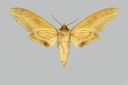
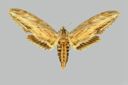
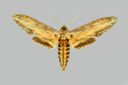
Sphinx franckii is a large sphinx moth native to eastern North America, first described by Berthold Neumoegen in 1893. have a wingspan of 100–128 mm and are active primarily at dusk and early morning. The shows strong fidelity to ash trees as native larval but has adapted to use ornamental lilac in suburban settings. Northern have a single annually, while southern populations may produce a partial second generation.
Pronunciation
How to pronounce Sphinx franckii: //ˈsfɪŋks ˈfraŋ.ki.aɪ//
These audio files are automatically generated. While they are not always 100% accurate, they are a good starting point.
Identification
can be distinguished from similar sphinx moths by their association with specific types—lowland deciduous woodland and suburban areas with lilac plantings—and their restricted eastern North American distribution. The is closely related to other ash-feeding sphinx moths but differs in and use patterns. Accurate identification may require examination of genitalia or molecular markers.
Images
Habitat
Primary is lowland deciduous woodland. The has also established in suburban areas where ornamental lilac (Syringa species) has been planted, extending its range into human-modified landscapes.
Distribution
Eastern United States, ranging from New York south to northern Florida, west to Missouri and Louisiana.
Seasonality
Northern : single with active late June to early July. Southern populations: partial second generation possible with adults active August to September.
Diet
nectar primarily from phlox (Phlox paniculata and cultivars). Males have been observed gathering over moist charcoal to obtain nutrients from charred wood prior to copulation. Larvae feed on native ash (Fraxinus) and fringe tree (Chionanthus virginicus), with documented use of ornamental lilac (Syringa) and occasional feeding on privet (Ligustrum).
Host Associations
- Fraxinus - native larval only native documented
- Chionanthus virginicus - native larval only native documented
- Syringa - non-native larval ornamental lilac; larvae show strong preference
- Ligustrum - occasional larval privet; used infrequently
- Phlox paniculata - nectar sourceprimary nectar plant including cultivars
Life Cycle
Complete with four stages: , larva, pupa, . Larvae pupate in subterranean chambers located a few inches beneath the soil surface. Northern are ; southern populations may be partially .
Behavior
fly at dusk and in early morning hours ( activity). Males exhibit a distinctive of gathering over moist charcoal to obtain nutrients from charred wood before mating. Larvae are commonly parasitized by native braconid wasps and threatened by introduced tachinid flies.
Ecological Role
function as , particularly of phlox. Larvae serve as prey for and tachinid flies. The contributes to nutrient cycling through larval feeding on woody plants and subsequent in soil.
Human Relevance
Considered a beneficial in gardens. Larvae may cause minor defoliation of ornamental lilac but are not regarded as significant pests. The has been studied as a model for understanding how native insects adapt to non-native plants following decline of native hosts.
Similar Taxa
- Sphinx chersisBoth are ash-feeding sphinx moths with overlapping eastern North American ranges; S. chersis is larger and has different
- Sphinx kalmiaeAnother ash- sphinx moth with similar requirements; differs in larval performance on non-native such as lilac
- Ceratomia undulosaAsh-dependent hawkmoth with similar ; belongs to different with distinct morphological features
More Details
Emerald Ash Borer Impact
As ash trees decline due to emerald ash borer (Agrilus planipennis) , S. franckii may become increasingly dependent on ornamental lilac and other non-native . Research indicates variable success on alternative hosts, with potential costs compared to native ash.
Conservation Status
Not formally assessed but potentially vulnerable due to plant loss. Preservation of remaining ash and careful management of lilac plantings in suburban areas may support population persistence.
Sources and further reading
- BugGuide
- Wikipedia
- GBIF taxonomy match
- iNaturalist taxon
- NCBI Taxonomy
- Catalogue of Life
- The Hornworms Are Not Your Friends | Bug Squad
- Don't Miss Bohart Museum Open House on Nov. 2 | Bug Squad
- Bug Eric: White-lined Sphinx ("Hummingbird Moth")
- For Ash-Dependent Insects, Some Plants Make Good Alternatives—But Others Don't
- Bug Eric: Moth Week and "Mothapalooza"
- Bug Eric: National Moth Week Recap, 2015