
Sphinx asellus
Rothschild & Jordan, 1903
Asellus Sphinx, asellus sphinx moth
Sphinx asellus is a sphinx moth in the Sphingidae, first described by Rothschild and Jordan in 1903. It inhabits arid woodlands of the southwestern United States, where fly during late spring and early summer. The has a single and larvae feed on manzanita species.
Pronunciation
How to pronounce Sphinx asellus: /ˈsfɪŋks æˈsɛləs/
These audio files are automatically generated. While they are not always 100% accurate, they are a good starting point.
Identification
The combination of large size (80–99 mm wingspan), in pinyon-juniper woodlands of the southwestern United States, and period from May to July distinguishes this from other sphinx moths in the region. Larvae feed on manzanita (Arctostaphylos), a association not shared by all regional Sphinx species.
Images
Appearance
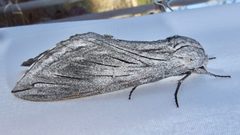
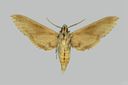
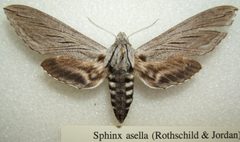
have a wingspan of 80–99 mm. As a sphinx moth, it has a robust, streamlined body typical of the , with narrow, elongated forewings and shorter hindwings. The body and wing patterning are adapted for camouflage in its woodland .
Habitat
Pinyon-juniper woodland and similar arid environments. The is associated with semi-arid montane and foothill where its larval plants grow.
Distribution
Southwestern United States: Colorado, Nevada, Utah, extreme south-western Wyoming, Arizona, New Mexico, and south-western Texas.
Seasonality
One per year. are on wing from May to July.
Diet
Larvae feed on manzanita (Arctostaphylos). feeding habits are not documented in available sources.
Host Associations
- Arctostaphylos - larval food plantmanzanita
Life Cycle
(one per year). Larvae feed on plants, then pupate. emerge and are active from May to July. Specific details of site and stage are not documented.
Similar Taxa
- Sphinx chersisAlso a Sphinx with large size, but associated with ash (Fraxinus) rather than manzanita; ranges overlap in southwestern United States
- Sphinx kalmiaeAnother ash-feeding Sphinx ; plant association and potentially similar appearance require careful differentiation
- Sphinx drupiferarumWild cherry sphinx with overlapping range; plants (Prunus) differ from manzanita
More Details
Taxonomic note
The name 'asellus' refers to a small crustacean (), though the reason for this epithet in a species is not documented in available sources.
Conservation context
As a feeder on manzanita, this may be vulnerable to changes affecting its plants in southwestern pinyon-juniper .
Sources and further reading
- BugGuide
- Wikipedia
- GBIF taxonomy match
- iNaturalist taxon
- NCBI Taxonomy
- Catalogue of Life
- The Hornworms Are Not Your Friends | Bug Squad
- Don't Miss Bohart Museum Open House on Nov. 2 | Bug Squad
- Bug Eric: White-lined Sphinx ("Hummingbird Moth")
- For Ash-Dependent Insects, Some Plants Make Good Alternatives—But Others Don't
- Bug Eric: Moth Week and "Mothapalooza"
- Study Examines Insects' Role in Plastic Pollution