
Cocytius antaeus
Drury, 1773
giant sphinx
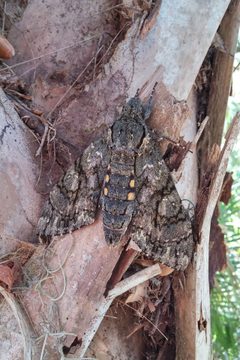
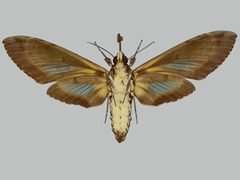
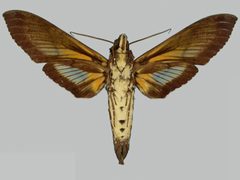
Cocytius antaeus is a large sphinx moth with a wingspan of 126–178 mm, found from Brazil through Central America to the southern United States. The is notable for its exceptionally long , which was once thought to be the only insect proboscis long enough to pollinate the ghost orchid in North America. It is very rare in the United States, with records limited to southern California, Texas, and Florida.
Pronunciation
How to pronounce Cocytius antaeus: //kəˈsaɪtiʊs ˈæntiəs//
These audio files are automatically generated. While they are not always 100% accurate, they are a good starting point.
Identification
Distinguished from other North American sphinx moths by its large size (wingspan exceeding 125 mm), very long , and narrow, pointed forewings. The gray-brown coloration with contrasting pale hindwing band separates it from similarly sized Manduca , which typically show more green or pink tones. The ghost orchid pollination association, though no longer considered exclusive, remains a notable field clue in Florida.
Images
Habitat
Tropical and subtropical lowland forests, particularly in areas with standing water or seasonally flooded conditions. In the United States, found in subtropical hardwood hammocks and cypress swamps. Larval centers on hostplants in wet or riparian forest edges.
Distribution
Brazil through Central America to southern United States (southern California, southern Texas, and southern Florida). First recorded from Isla del Coco (Cocos Island), Rica in 2009, representing an oceanic island extension of its range.
Diet
feed on nectar. Larvae feed on leaves of Annona (Annonaceae): Annona glabra, Annona reticulata, Annona purpurea, Annona holosericea, and Rollinia membranacea.
Host Associations
- Annona glabra - larval foodplantpond apple, native to Florida and tropics
- Annona reticulata - larval foodplantcustard apple
- Annona purpurea - larval foodplantsoncoya
- Annona holosericea - larval foodplant
- Rollinia membranacea - larval foodplantwild sugar apple
Life Cycle
Complete with , larva, pupa, and stages. Larvae feed on Annona foliage. occurs in a subterranean chamber. Adults are strong fliers and may disperse considerable distances.
Behavior
are powerful, fast fliers active during twilight and night. The exceptionally long allows feeding on deep-throated flowers including orchids. Adults have been documented visiting the ghost orchid (Dendrophylax lindenii) in Florida, though they are no longer considered the sole .
Ecological Role
function as of deep-throated flowers, including orchids with long nectar spurs. Larvae are folivores on Annona , representing a specialized herbivore in tropical forest .
Human Relevance
Subject of conservation interest due to rarity in North America and association with the endangered ghost orchid. Collected by lepidopterists and studied for its remarkable .
Similar Taxa
- Manduca sextaSimilar large size and sphinx moth form, but Manduca shows green or pink coloration with more rounded forewings and lacks the very long
- Manduca rusticaComparable wingspan but distinguished by green forewings with rusty markings and different abdominal pattern
- Amphimoea walkeriAnother large sphingid with extremely long , but occurs in different geographic range (Central America and Caribbean islands) and shows different wing pattern
Misconceptions
Once believed to be the only insect in North America capable of pollinating the ghost orchid (Dendrophylax lindenii) due to its uniquely long . This is no longer considered accurate, as other long-tongued have been documented visiting the orchid.
More Details
Proboscis length
Possesses one of the longest proboscides of any North American , estimated at 10–12 cm or more, enabling access to nectar in deep floral tubes
Rarity in North America
Considered one of the rarest sphinx moths in the United States; most records are of single individuals or small series
Sources and further reading
- BugGuide
- Wikipedia
- GBIF taxonomy match
- iNaturalist taxon
- NCBI Taxonomy
- Catalogue of Life
- Ascalaphidae | Beetles In The Bush
- August | 2022 | Beetles In The Bush
- Insecta | Beetles In The Bush | Page 5
- Insecta, Lepidoptera, Sphingidae, Cocytius antaeus Drury: first record for Isla del Coco, Costa Rica and notes on its hostplant