
Xylophanes falco
Walker, 1856
Falcon Sphinx
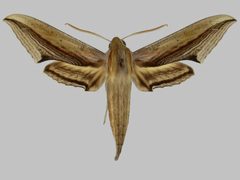
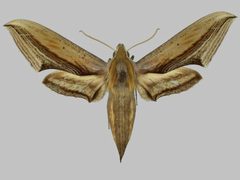
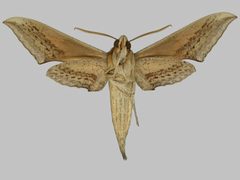
Xylophanes falco is a medium-sized sphinx moth in the Sphingidae, commonly known as the Falcon Sphinx. It occurs from Central America through Mexico into the southwestern United States. are distinguished from similar by their pale brown-beige coloration, more falcate forewings, and sharply defined wing pattern lines. The species inhabits oak woodlands and riparian corridors.
Pronunciation
How to pronounce Xylophanes falco: //zaɪˈlɒfəniːz ˈfælkoʊ//
These audio files are automatically generated. While they are not always 100% accurate, they are a good starting point.
Identification
Distinguished from Xylophanes monzoni by generally paler coloration, less diffuse wing pattern, and more falcate forewings. The sharply defined postmedian and submarginal lines that converge to the apex contrast with the more diffuse patterning of X. monzoni. The pale brown-beige ground color and purple suffusion at the wing base are additional distinguishing features.
Images
Appearance
Wingspan 70–80 mm. Forewings more falcate (sickle-shaped) than related . Forewing upperside pale brown-beige from base to apex, with scattered black scales restricted to leading edge to discal spot. Base of forewing has pale purple suffusion with traces of two lines running from inner margin. Five dark brown postmedian lines and two submarginal lines present, all sharply defined and converging to apex. Hindwing upperside pale brown with median band of two thin, straight, dark brown lines. Submarginal band similar in color and width to median lines, distinctly darker than grey marginal band. with long, pale hair-like .
Habitat
Oak woodland and along streamsides.
Distribution
Honduras and Guatemala north through Mexico to southern Arizona and western Texas.
Seasonality
on wing June to September in Arizona; continuous in tropical portions of range.
Diet
Larvae possibly feed on Bouvardia glaberrima (Rubiaceae).
Life Cycle
Larva with single large on , six white circles down side of body, and extensive bands of white dots girdling .
Similar Taxa
- Xylophanes monzoniSimilar in overall appearance but differs in having darker, more diffuse wing patterning and less falcate forewings.