
Proserpinus lucidus
Boisduval, 1852
Pacific green sphinx, bear sphinx
Proserpinus lucidus is a small sphinx moth native to the Pacific coast of North America. are active in winter from December to April, during which they do not feed. The exhibits unusual seasonal timing among North American sphinx moths, with adults emerging and mating during the coldest months. Larvae feed on specific evening primrose relatives in the Clarkia and Camissonia, and possess a distinctive "bullseye" spot in place of the typical horn found in most sphinx moth caterpillars.
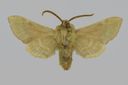
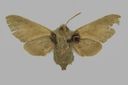
Pronunciation
How to pronounce Proserpinus lucidus: /proʊˈsɜrpɪnəs ˈluːsɪdəs/
These audio files are automatically generated. While they are not always 100% accurate, they are a good starting point.
Identification
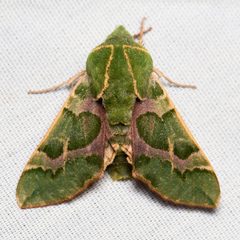
can be distinguished from other Proserpinus by the combination of green forewings with pink-purple transverse bands outlined in yellow, and by their winter period (December–April). The larval "bullseye" spot in place of a horn separates it from most other sphinx moth caterpillars; this trait is shared with some related Proserpinus species but the specific plant associations and geographic range help confirm identification.
Images
Habitat
Associated with coastal and inland where plants in the Clarkia and Camissonia occur. Larval habitat includes areas with evening primrose relatives; are attracted to lights in various settings.
Distribution
Pacific coast of the United States: Washington, Idaho, Oregon, and California; extends into Mexico. The distribution corresponds to the range of its larval plants.
Seasonality
fly in a single during winter months, from December to April. This represents an unusual for a North American sphinx moth, with peak activity during the coldest part of the year.
Diet
do not feed during their adult stage. Larvae feed on Clarkia breweri, Clarkia modesta, and probably Clarkia purpurea; also recorded from Camissonia bistorta and Camissonia strigulosa (all in Onagraceae).
Host Associations
- Clarkia breweri - larval food plantconfirmed
- Clarkia modesta - larval food plantconfirmed
- Clarkia purpurea - larval food plantprobable
- Camissonia bistorta - larval food plantconfirmed
- Camissonia strigulosa - larval food plantconfirmed
Life Cycle
hatch and larvae develop over approximately 4–5 weeks. Caterpillars reach 5 cm before pupating. occurs under leaf litter or by burrowing up to 16.5 cm into the root mass of plants. emerge the following winter after a pupal lasting approximately 8–10 months. The spans roughly one year with a single .
Behavior
are attracted to lights. Females typically remain stationary and emit to attract males rather than engaging in active for mate location. Adults do not feed, relying entirely on energy reserves accumulated as larvae.
Ecological Role
Larval herbivore on native evening primrose relatives; contributes to nutrient cycling through herbivory and subsequent decomposition. serve as potential prey for during winter months when few other large moths are active.
Human Relevance
Occasionally attracted to artificial lights, bringing it to human attention. Of interest to lepidopterists due to its unusual winter period and distinctive appearance. No significant economic or agricultural impact recorded.
Similar Taxa
- Proserpinus gauraeSimilar size and general body plan, but P. gaurae occurs in different geographic range (Great Plains and eastern regions) and has different period and plant associations
- Other Proserpinus speciesShare green coloration and small size, but differ in wing pattern details, geographic distribution, and seasonal timing of activity
- Hemaris spp. (hummingbird moths)Similar small size and day-flying in some , but Hemaris have clear wings and different body shape; are active in summer rather than winter
More Details
Taxonomic note
The has been treated under the synonym Arctonotus lucidus in some older literature, but Proserpinus lucidus is the currently accepted name.
Pupal behavior
The deep burrowing of prepupal larvae (up to 16.5 cm) is unusual among sphinx moths and may provide protection from winter conditions and .