
Proserpinus
Hübner, 1819
day sphinxes, evening primrose hawkmoths
Species Guides
7- Proserpinus clarkiae(Clark's sphinx)
- Proserpinus flavofasciata(yellow-banded day sphinx)
- Proserpinus gaurae(proud sphinx moth)
- Proserpinus juanita(Juanita sphinx)
- Proserpinus lucidus(Pacific green sphinx)
- Proserpinus terlooii(Terloo sphinx moth)
- Proserpinus vega(vega sphinx moth)
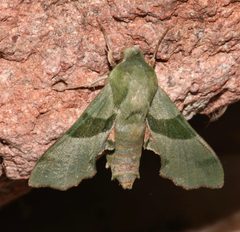
Proserpinus is a of seven hawkmoth in the Sphingidae. Most species are native to North America, with P. proserpina having a much broader distribution extending from Europe and Asia to Africa. are generally and exhibit green forewings with orange or red hindwings, though P. flavofasciata displays black and yellow coloration. Larvae specialize on plants in the evening primrose family (Onagraceae), with P. terlooii feeding on Nyctaginaceae instead.
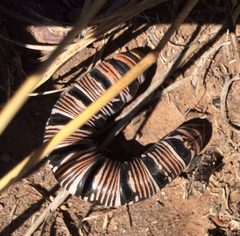
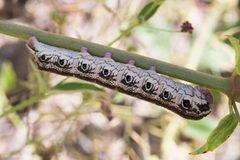
Pronunciation
How to pronounce Proserpinus: /proʊˈsɜːrpɪnəs/
These audio files are automatically generated. While they are not always 100% accurate, they are a good starting point.
Identification
The combination of activity, green forewings with contrasting orange or red hindwings, and the distinctive hovering distinguishes most Proserpinus from other North American Sphingidae. P. flavofasciata is readily identified by its black and yellow coloration, unique within the . P. terlooii and P. flavofasciata can be separated from by their larval associations with Nyctaginaceae.
Images
Appearance
typically have green forewings with orange or red hindwings. P. flavofasciata is an exception with black and yellow coloration. The exhibits the robust, streamlined body form typical of Sphingidae with narrow, elongated forewings.
Habitat
supporting larval plants in Onagraceae, particularly evening primroses (Oenothera) and willowherbs (Epilobium). For P. proserpina, sites with competitive willowherb are required for successful maintenance. P. terlooii occupies habitats with spiderlings (Nyctaginaceae).
Distribution
North America for most . P. proserpina has a much larger range extending from Europe and Asia to Africa. GBIF records indicate presence in Denmark and Sweden.
Diet
feed on nectar from flowers. Larvae specialize on Onagraceae: P. proserpina develops on willowherbs (Epilobium spec.), and feed on evening primroses and related . P. terlooii larvae feed on spiderlings (Nyctaginaceae).
Host Associations
- Onagraceae (evening primrose family) - larval primary for most
- Epilobium spec. (willowherbs) - larval specifically for P. proserpina
- Nyctaginaceae (four o'clock family) - larval for P. terlooii
Behavior
hover in front of flowers to feed on nectar, resembling hummingbirds in . This hovering is characteristic of the Sphingidae and has been observed in Proserpinus .
Ecological Role
function as while feeding on nectar. Larvae are specialized herbivores on Onagraceae, with potential roles in regulating plant .
Human Relevance
P. proserpina is strictly protected under Annex IV of the EU Directive (92/43/EEC), requiring consideration in planning and approval procedures. Conservation measures include site preparation and planting of competitive willowherb rhizomes. The is of interest to collectors and entomologists; P. gaurae has been used in specimen exchanges among collectors.
Similar Taxa
- Other Macroglossinaeshare hovering and general body form, but differ in coloration and activity patterns
- Hemaris (clearwing moths)similar activity and hovering , but distinguished by transparent wings and different coloration
More Details
Taxonomic Note
Arctonotus lucidus may be included as P. lucidus, representing taxonomic uncertainty in the .
Conservation Status
P. proserpina implementation challenges in conservation practice despite legal protection, requiring intensive professional supervision for successful management.