
Aspilanta viticordifoliella
(Clemens, 1860)
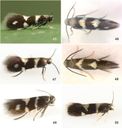
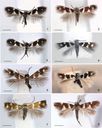
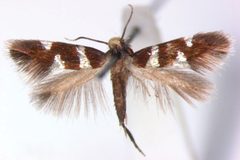
Aspilanta viticordifoliella is a small leafmining in the Heliozelidae, originally described as Antispila viticordifoliella by Clemens in 1860 and transferred to the new Aspilanta in 2020 based on phylogenetic analysis. The is characterized by reduced wing venation and distinctive silvery forewing markings without an spot. Its larvae are specialized leaf miners on Vitaceae plants.
Pronunciation
How to pronounce Aspilanta viticordifoliella: /ˌæspɪˈlæntə ˌvaɪtɪˌkɔːrdɪfəʊlˈiːlə/
These audio files are automatically generated. While they are not always 100% accurate, they are a good starting point.
Identification
Images
Habitat
Associated with supporting its Vitaceae plants: Virginia creeper, false Virginia creeper, and frost grape. These include woodland edges, forest openings, and riparian areas in eastern North America.
Distribution
Eastern North America. Recorded from Canada (Ontario, Québec) and United States (Connecticut, Florida, Kentucky, Massachusetts, New York, Pennsylvania, Vermont).
Seasonality
active during warmer months; larvae present when foliage is available. Pupal cases overwinter, with following cold stratification from October/November through February/April.
Diet
Larval leaf mining on Vitaceae: Virginia creeper (Parthenocissus quinquefolia), false Virginia creeper (Parthenocissus vitacea), and frost grape (Vitis vulpina).
Host Associations
- Parthenocissus quinquefolia - larval Virginia creeper
- Parthenocissus vitacea - larval false Virginia creeper
- Vitis vulpina - larval frost grape
Life Cycle
deposited on leaf. Larva mines leaf tissue, creating a compact blotch mine sometimes preceded by a short linear portion. Mature larva cuts a 3.5–4 mm elliptical case from the leaf, exits through the resulting hole, and pupates within the case. Overwinters as pupal case with cold stratification required for .
Behavior
Larval mining produces distinctive leaf mines with black in a thick clump near the mine beginning, becoming more dispersed toward the center. Mature larva excises a precise case from the leaf for , leaving a clean elliptical hole.
Ecological Role
Herbivore on native Vitaceae; leafmining activity creates minor damage to foliage. Serves as host for including Chalcidoidea and Braconidae (Microgastrinae).
Human Relevance
Minor economic interest as a native herbivore on grape relatives; no significant pest status reported. Contributes to biodiversity documentation and understanding of leafminer-plant associations.
Similar Taxa
- Aspilanta ampelopsifoliellaSimilar size and association with Vitaceae; distinguished by presence of spot on forewings absent in A. viticordifoliella.
- Antispila speciesFormerly classified in same ; distinguished by white-tipped in A. viticordifoliella versus non-white-tipped antennae in Antispila.
More Details
Taxonomic history
Transferred from Antispila to the newly erected Aspilanta in 2020 based on phylogenetic analysis showing reduced wing venation characterizes a distinct clade.
Pupal case
The 'shield-bearer' for Heliozelidae refers to this case-cutting ; the larva carries and pupates within a portable case cut from the leaf.