
Vespula consobrina
(de Saussure, 1854)
Blackjacket
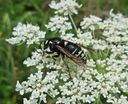
Vespula consobrina, commonly called the blackjacket, is a of social in the Vespidae. It is native to North America and is distinguished by its black and white coloration. Unlike many other yellowjacket species, it is not known to scavenge at human food sources and maintains a strictly predatory lifestyle. Colonies are relatively small and nest underground in concealed locations.
Pronunciation
How to pronounce Vespula consobrina: /ˈvɛspʊlə kɔnsoˈbria/
These audio files are automatically generated. While they are not always 100% accurate, they are a good starting point.
Identification
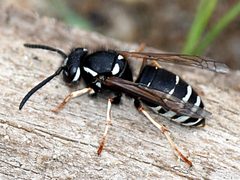
The blackjacket can be distinguished from other yellowjacket by its black and white coloration (lacking yellow), which is unique among Vespula species in its range. It resembles a smaller version of the baldfaced (Dolichovespula maculata), but can be separated by -level characteristics and nest placement. Unlike Vespula species with yellow markings, the blackjacket's stark black and white pattern is diagnostic. are smaller than queens and males.
Images
Appearance
Medium-sized social with striking black and white coloration. Queens measure approximately 17 mm, female 10–12 mm, and males 15–16 mm. The displays distinct black and white longitudinal stripes. The overall color pattern resembles a smaller version of the baldfaced (Dolichovespula maculata), with sparse white lines on a predominantly black body.
Habitat
Forested areas where it rarely encounters humans. Nests are constructed in abandoned rodent burrows, rotten or fallen trees, hollow walls, and rock cavities. The shows a strong preference for concealed, subterranean or cavity-nesting sites rather than exposed aerial nests.
Distribution
Canada (all provinces and territories except Nunavut) and the northern United States. Records exist from Vermont and other northern states.
Diet
Strictly predatory, feeding on other insects and arthropods. capture prey to feed developing larvae in the colony. Has not been observed scavenging at human food sources or carrion.
Life Cycle
colony cycle typical of temperate Vespula . A single initiates a new colony in spring after . The colony grows through summer, producing , then new queens and males in late summer or early fall. Mating occurs before winter, after which the founding queen, workers, and males die. Newly mated queens overwinter in protected locations and emerge the following spring to establish new colonies. Colonies remain relatively small compared to other yellowjacket species.
Behavior
Social living in colonies with division of labor among , , and males. Workers are responsible for nest construction, foraging, and larval care. The is described as scarce and rarely encountered by humans due to its forested preferences and non-scavenging . Defensive behavior around nests has been observed but is less frequently triggered than in species that nest near human activity.
Ecological Role
of other insects and arthropods, contributing to natural pest control in forest . As a strictly predatory , it does not engage in the scavenging that brings other yellowjackets into conflict with humans. The species likely serves as prey for various vertebrates including birds, bears, raccoons, and skunks.
Human Relevance
Minimal direct interaction with humans due to forested preferences and lack of scavenging . Stings are possible if nests are disturbed, but encounters are rare. Not considered a significant pest . The species has been used in venom extraction for allergy immunotherapy treatments.
Similar Taxa
- Dolichovespula maculata (Baldfaced Hornet)Similar black and white coloration and pattern, but larger in size and builds exposed aerial nests rather than subterranean or cavity nests. Belongs to a different with distinct morphological features.
- Vespula pensylvanica (Western Yellowjacket)Same but has yellow and black coloration rather than black and white. Western yellowjackets are abundant scavengers at human food sources, whereas blackjackets are strictly predatory and scarce.
- Vespula maculifrons (Eastern Yellowjacket)Same with yellow and black banding rather than black and white. Eastern yellowjackets are common and often nest in similar underground locations, but their color pattern readily distinguishes them.
Misconceptions
The 'blackjacket' is also applied to Dolichovespula maculata (the baldfaced ), leading to potential confusion. These are distinct in different with different nesting habits.
More Details
Conservation Status
Described as scarce in available literature, suggesting naturally low densities rather than conservation concern.
Taxonomic Note
One of approximately 20 recognized of yellowjackets in North America, distinguished within the Vespula by its unique black and white coloration.
Sources and further reading
- BugGuide
- Wikipedia
- GBIF taxonomy match
- iNaturalist taxon
- NCBI Taxonomy
- Catalogue of Life
- The Wonderful World of Wasps | Bug Squad
- Bug Eric: Life in a Paper Palace
- Bug Eric: March 2014
- Surprise visit by a queen: German yellowjacket, Vespula germanica — Bug of the Week
- Fierce Southern Stingers in the DMV: Southern Yellowjackets, Vespula squamosa — Bug of the Week
- Summer stingers – Eastern yellowjackets, Vespula maculifrons — Bug of the Week