
Symmorphus cristatus
(de Saussure, 1856)
Tufted Potter Wasp
Symmorphus cristatus is a solitary mason wasp in the Eumeninae, widely distributed across North America. It is a of leaf beetle larvae (Chrysomelidae), which it paralyzes and provisions in mud-partitioned nest . The exhibits trap-nesting , utilizing pre-existing cavities in dead wood rather than constructing free-standing nests. It serves as a significant agent for several leaf beetle species and is subject to by cuckoo wasps.
Pronunciation
How to pronounce Symmorphus cristatus: /sɪˈmɔrfəs krɪˈsteɪtəs/
These audio files are automatically generated. While they are not always 100% accurate, they are a good starting point.
Identification
Distinguished from S. albomarginatus and S. canadensis by narrower metasomal , smaller cephalic foveae positioned closer together, and conspicuous hind femoral hairs. Males identified by large pale clypeal spot and simple (unhooked, uncoiled) terminal antennal segment. Females lack the prominent clypeal spot. Eumenine recognized by single spur on middle tibia and cleft tarsal claw; Symmorphus specifically by absence of petiole and presence of carina and groove on first abdominal segment.
Images
Appearance
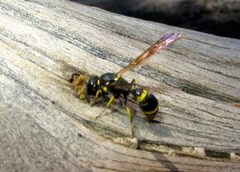
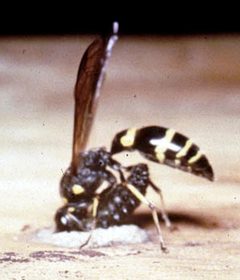
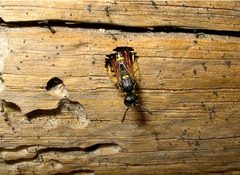
Small, slender mason wasp with wing length 5.0–9.0 mm. Metasomal narrower than S. albomarginatus and S. canadensis when viewed dorsally. Cephalic foveae (depressions adjacent to ocelli) smaller and more closely spaced than in S. canadensis. Hind bears conspicuous hairs, absent in S. canadensis. Body markings range from pale to yellow. Males approximately 20% smaller than females and possess a large pale spot on the above the ; females have a small or absent spot. First abdominal segment lacks a petiole and bears a horizontal carina and shallow vertical groove dorsally.
Habitat
Found in areas with floral resources for nectar feeding, dead wood or logs providing nest cavities, and presence of chrysomelid larvae. Nests in pre-existing holes approximately 5 mm diameter, frequently in lodgepole pine (Pinus contorta) in Sierra Nevada. Adults observed on flowers of Apiaceae including fennel, Anne's lace, cow parsnip, and swamp whiteheads. Associated with colonies where adults feed on honeydew.
Distribution
Transcontinental across Canada from west to east coast. Northern and mountainous regions of the United States. In California: Sierra Nevada from Inyo to Siskiyou County and San Francisco Bay Area. Documented in Colorado, Illinois, and eastern North America.
Seasonality
activity period includes spring through summer; specific seasonal patterns vary by latitude and elevation. Nest construction and provisioning occurs during active foraging period.
Diet
feed on nectar from diverse flowers and honeydew from colonies. Larvae provisioned exclusively with paralyzed larvae of leaf beetles (Chrysomelidae), including Gonioctena americana, Chrysomela scripta, Chrysomela crotchi, Chrysomela aeneicollis, Chrysomela schaefferi, and Plagiodera californica. Prey selection includes both -plant derived secretion-bearing larvae and autogeneously defended .
Life Cycle
Solitary trap-nesting with complete . Female locates pre-existing cavity ( boring, hollow twig), partitions tunnel into multiple with mud or clay curtains, and works from back to front. Lays in cell, then provisions with several paralyzed leaf beetle larvae. Number of prey per cell varies with prey size and offspring sex (female larvae require more food). Nest typically contains multiple cells; often completed with empty vestibular cell and may include vacant intercalary cells between provisioned cells. Developmental timing not explicitly documented.
Behavior
Trap-nesting : rents pre-existing cavities rather than excavating or building free-standing nests. Efficient provisioning: nests of completed in approximately 3 days. Sex determination: females control offspring gender through . Defensive behavior observed: females actively fend off cuckoo wasps at nest entrances. Honeydew feeding: frequent colonies for intake.
Ecological Role
Major mortality factor for of several leaf beetle . Complementary to fly Parasyrphus melanderi on Chrysomela aeneicollis: fly preys on and young larvae, S. cristatus specializes on third instar larvae. agent for defoliating beetles. for including cuckoo wasp Chrysis nitidula.
Human Relevance
Beneficial insect contributing to natural suppression of leaf beetle pests. Can be attracted to residential using drilled wooden blocks (3–4 mm diameter holes, up to 6 inches deep) placed in sheltered locations. May help reduce defoliation of trees and shrubs by leaf beetle larvae. Not aggressive toward humans; sting used only for prey capture.
Similar Taxa
- Symmorphus canadensisOverlapping distribution; distinguished by absence of hind femoral hairs, smaller body size, and more widely spaced cephalic foveae
- Symmorphus albomarginatusOverlapping distribution; distinguished by broader metasomal and different body proportions
- Symmorphus projectusWestern North American distribution; strictly western range from Pacific Northwest to Montana, Wyoming, and southward
More Details
Nest parasitism
Nests frequently parasitized by cuckoo wasps (Chrysis nitidula, Chrysididae), eulophid (Melittobia), wasps (Monodontomerus), and satellite flies (Amobia). Also subject to by Grain Itch Mite (Pyemotes ventricosus) and scavenging by phorid flies and dermestid beetles.
Prey handling
Prey bear anti- defenses including external secretion glands with volatile compounds; S. cristatus is not repelled by -plant derived or autogeneously synthesized defensive secretions. sting larvae to immobilize, then cache multiple individuals per .
Sources and further reading
- BugGuide
- Wikipedia
- GBIF taxonomy match
- iNaturalist taxon
- NCBI Taxonomy
- Catalogue of Life
- Bug Eric: Wasp vs. Wasp
- Bug Eric: Wasp Wednesday: Symmorphus
- Bug vs. bug - Assassinating stink bugs is the game of the wheel bug, Arilus cristatus — Bug of the Week
- Death of a stink bug, Part 2: Bug vs. Bug - Brown Marmorated Stink Bug, Halyomorpha halys, meets the wheel bug, Arilus cristatus — Bug of the Week
- To eat a stink bug, part 3 - Bug vs Bug, Brown Marmorated Stink Bug, Halyomorpha halys, meets the wheel bug, Arilus cristatus — Bug of the Week
- Bugs in orange and black: Three assassins - milkweed assassin bug, Zelus longipes; orange assassin bug, Pselliopus barberi; and wheel bug, Arilus cristatus — Bug of the Week
- Nesting Behavior and Prey Use in Two Geographically Separated Populations of the Specialist Wasp Symmorphus cristatus (Vespidae: Eumeninae)