
Symmorphus canadensis
(de Saussure, 1855)
Canadian potter wasp, Canadian mason wasp
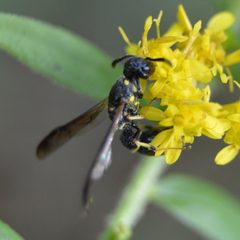
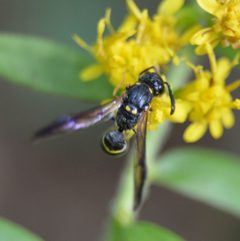
Symmorphus canadensis is the smallest North American in the Symmorphus, measuring approximately 6–10 mm. This solitary mason wasp specializes in hunting leaf beetle larvae, weevil larvae, and leaf-mining caterpillars to provision nests constructed in pre-existing cavities. Females partition nest tunnels into multiple using mud partitions, laying one per cell atop paralyzed prey. The species is transcontinental across North America, absent only from Florida, Texas, New Mexico, and Arizona.
Pronunciation
How to pronounce Symmorphus canadensis: //sɪˈmɔrfəs ˌkænəˈdɛnsɪs//
These audio files are automatically generated. While they are not always 100% accurate, they are a good starting point.
Identification
Symmorphus canadensis is the smallest of the four North American Symmorphus . The is distinguished by a horizontal ridge (carina) on the first abdominal tergite and a shallow vertical groove on the same segment. Males have simple terminal antennal segments, unlike the hooked or coiled segments found in other eumenid genera. Compared to , S. canadensis is smaller than S. albomarginatus, S. cristatus, and S. projectus. The species is slender-bodied relative to most other mason wasps, with males particularly slender.
Images
Habitat
Occupies pre-existing cavities in dead wood, hollow twigs, and stems. Readily accepts artificial nesting substrates including drilled holes in wooden blocks (3–4 mm diameter, up to 6 inches deep). Associated with dead, standing or fallen trees with bark stripped, particularly in shaded locations.
Distribution
Transcontinental across North America, ranging from Alaska and Canada southward throughout the eastern and western United States. Absent from Florida, Texas, New Mexico, and Arizona. Documented in Vermont and Colorado.
Seasonality
active during spring and summer months. One documented 7- nest was completed in approximately three days during the active season.
Diet
feed on honeydew secreted by aphids. Females hunt leaf beetle larvae (Chrysomelidae), weevil larvae (Curculionidae), and leaf-mining caterpillars to provision nests. The number of prey items per varies with prey size and offspring sex, with female larvae generally receiving more food.
Life Cycle
Females construct nests in pre-existing cavities, partitioning tunnels into multiple with mud curtains. Each cell receives one laid on the last paralyzed prey item. Nests typically contain multiple provisioned cells and may include empty "vestibular" cells at the entrance and "intercalary" cells between provisioned cells, possibly as defenses against . Development proceeds through egg, larval, and pupal stages within individual cells.
Behavior
Females demonstrate efficient nest provisioning, completing multi- nests rapidly. They defend nest entrances against parasitic cuckoo wasps and other intruders. Males are smaller and more slender than females, and are observed harassing females for mating opportunities. may modify nest entrances by chewing wood fibers to expand openings or applying mud/resin to shrink them.
Ecological Role
of leaf beetle larvae, weevil larvae, and leaf-mining caterpillars, contributing to regulation of herbivorous insect . Serves as for multiple including cuckoo wasps (Chrysididae), eulophid (Melittobia), wasps (Monodontomerus), and satellite flies (Amobia). Nests may be infested by the Grain Itch Mite (Pyemotes ventricosus). Scavengers including phorid flies and dermestid beetles may destroy while consuming stored prey.
Human Relevance
Beneficial insect that helps control leaf beetle and weevil on trees and shrubs. Readily accepts artificial nesting blocks (" condos"), making it accessible for observation and in gardens. Not a structural pest; does not cause damage to sound wood.
Similar Taxa
- Symmorphus cristatusOverlapping transcontinental distribution; distinguished by larger size
- Symmorphus albomarginatusOverlapping range in Alaska, California, New Mexico, Quebec, and eastern U.S.; distinguished by larger size
- Symmorphus projectusPotentially sympatric in western North America; distinguished by larger size and strictly western distribution
- Trypoxylon spp.Co-occurs in borings; distinguished by different prey (spiders vs. beetle larvae) and different nest construction
- Passaloecus spp.Co-occurs in borings; distinguished by smaller size, prey, and different body proportions