
Euodynerus leucomelas
(de Saussure, 1856)
Black-and-white Mason Wasp
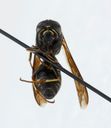
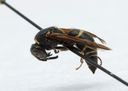
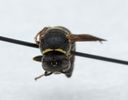
Euodynerus leucomelas is a mason wasp in the Eumeninae, commonly known as the Black-and-white Mason Wasp. It is widely distributed across the conterminous United States. Like other members of its , it is a solitary that provisions nests with paralyzed caterpillars for its larval offspring. The exhibits the typical 'chunky' characteristic of Euodynerus.
Pronunciation
How to pronounce Euodynerus leucomelas: //juː.əʊˈdɪnɪrəs ˌljuːkəˈmiːləs//
These audio files are automatically generated. While they are not always 100% accurate, they are a good starting point.
Identification
Identified as a member of Euodynerus by the blocky, angular . Distinguished from similar such as Euodynerus hidalgo by differences in pronotal carina and abdominal tergite margins, though specific diagnostic features for E. leucomelas require closer examination. Males can be recognized by hooked tips, as is typical for the .
Images
Distribution
Widely distributed across the conterminous 48 United States. GBIF records indicate presence throughout the contiguous US.
Diet
feed on nectar from flowers. Larvae are provisioned with paralyzed caterpillars, as is characteristic of mason wasps in the Eumeninae.
Life Cycle
Solitary nesting typical of Eumeninae: females construct or occupy pre-existing cavities, provision with paralyzed caterpillars, lay , and seal cells with mud partitions. Multiple cells may be constructed in sequence within a single nest tunnel.
Behavior
Nesting includes use of pre-existing cavities such as abandoned nests, old burrows, or holes in wood. Females hunt caterpillars, paralyze them with venom, and transport them to nest . is not practiced; cells are fully stocked before sealing.
Ecological Role
of caterpillars, providing of larvae including potential pest . contribute to pollination as flower visitors.
Human Relevance
May occupy artificial nest blocks designed for solitary bees. Non-aggressive; poses minimal sting risk due to solitary lifestyle and lack of colony defense .
Similar Taxa
- Euodynerus hidalgoVery common and widespread with similar overall appearance; distinguished by strong pronotal carina and upturned hind margins of second and third abdominal tergites
- Euodynerus annulatusSimilar size and distribution; distinguished by less angulate propodeum and non-reflexed tergite margins, plus unique burrow-excavating nesting with mud chimney
- Euodynerus foraminatusWidespread with similar nesting in pre-existing cavities; specific morphological differences require detailed examination
More Details
Taxonomic Note
Euodynerus leucomelas is placed in Vespidae by most modern sources (NCBI, iNaturalist), though some sources (GBIF ) list it under Eumenidae, reflecting ongoing taxonomic debate about the rank of this group.
Data Limitations
Detailed , specific prey records, and precise morphological diagnostics for E. leucomelas specifically are sparse in the provided sources. Much of the -level is inferred from better-studied such as E. hidalgo, E. annulatus, and E. foraminatus.