
Euodynerus hidalgo boreoorientalis
(Bequaert, 1937)
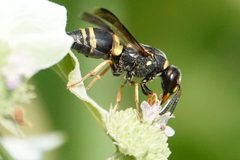
A of mason wasp in the Eumeninae, distributed along the Eastern Seaboard of North America. Females nest in pre-existing cavities such as old or borings in twigs and stalks, provisioning with paralyzed caterpillars. This subspecies is distinguished from the nominate form by reduced red coloration, appearing mostly black with sparse yellow markings.

Pronunciation
How to pronounce Euodynerus hidalgo boreoorientalis: /juːəʊˈdaɪnərəs hɪˈdælɡoʊ bɔːriˌɔːriɛnˈteɪlɪs/
These audio files are automatically generated. While they are not always 100% accurate, they are a good starting point.
Identification
Distinguished from Euodynerus hidalgo hidalgo by having almost no red markings, being mostly black with sparse yellow markings. The E. hidalgo is identified by the strong carina on the front edge of the pronotum and the thin, slightly upturned hind margins of the second and third abdominal segments. Male specimens have hooked tips on the . Distinguished from E. annulatus by the more angulate propodeum and the clear, reflexed hind margins of the first and second dorsal abdominal segments.
Images
Habitat
Nests in pre-existing cavities including old solitary burrows and borings in twigs and stalks. Found in coastal and near-coastal environments along the Eastern Seaboard.
Distribution
Eastern Seaboard of the United States, from New England southward. Documented from New Jersey, North Carolina, and Vermont.
Seasonality
Active during warmer months; observed in June and October. At least two produced per year based on research at Kill Devil Hills, North Carolina.
Diet
feed on nectar from wildflowers. Larvae are provisioned with paralyzed caterpillars from various .
Life Cycle
Nests consist of one to eleven arranged linearly along the tunnel length. Each cell contains several small paralyzed caterpillars with a single laid among them. Cells are separated by partitions of sand or soil. Egg and larval stages complete in 7-9 days. Male emerge from pupae in about 14 days, females in about 19 days.
Behavior
Females construct nests in pre-existing cavities rather than excavating burrows. They paralyze caterpillars with their sting and stock with multiple prey items. frequently visit wildflowers for nectar.
Ecological Role
of caterpillars, including pest . Contributes to pollination through nectar feeding. Serves as for nest including sapygid .
Human Relevance
Beneficial insect that helps control caterpillar in gardens and natural areas. Will use artificial nest blocks (' blocks') with appropriate diameter holes. Non-aggressive; does not defend nests and rarely stings humans.
Similar Taxa
- Euodynerus hidalgo hidalgoNominate with more extensive red markings; found in southern United States including Texas
- Euodynerus annulatusOverlapping range but excavates burrows with mud chimneys rather than using pre-existing cavities; less angulate propodeum
Sources and further reading
- BugGuide
- GBIF taxonomy match
- iNaturalist taxon
- Catalogue of Life
- UC Davis Seminar: Fly Research Could Provide Some Answers on Schizophrenia Disorder | Bug Squad
- Bug Eric: Wasp Wednesday: Euodynerus hidalgo
- Bug Eric: Wasp Wednesday: Euodynerus annulatus
- Extreme sexual dimorphism in Buprestidae: Xenorhipis hidalgoensis | Beetles In The Bush
- Bug Eric: The Mason Wasp Euodynerus foraminatus Endorses Bee Blocks
- Bug Eric: More Drama at the Bee Block