
Ancistrocerus tuberculocephalus
(de Saussure, 1853)
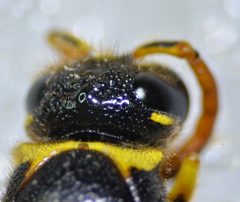
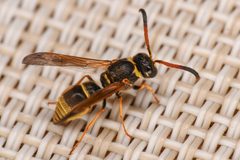
Ancistrocerus tuberculocephalus is a solitary mason wasp in the Eumeninae. The is divided into two with distinct geographic ranges in western North America. Females nest in pre-existing cavities including abandoned mud dauber nests, hollowed sumac twigs, and old borings in dead wood. They provision each with paralyzed caterpillars as food for their developing larvae. The species has been observed feeding on honeydew.
Pronunciation
How to pronounce Ancistrocerus tuberculocephalus: //ænˌsɪstroʊˈsɪərəs tuːˌbɜrkjʊloʊˈsɛfələs//
These audio files are automatically generated. While they are not always 100% accurate, they are a good starting point.
Identification
Mason wasps in the Ancistrocerus can be identified by a prominent transverse ridge on the base of the first abdominal segment, creating an abrupt angle. Like other members of the Vespidae, they fold their wings longitudinally when at rest. The is divided into two : A. tuberculocephalus sutterianus and A. tuberculocephalus tuberculocephalus, distinguished by geographic distribution rather than consistent morphological differences visible to observers.
Images
Habitat
Found in areas where nesting resources are available, including locations with abandoned mud dauber nests, sumac stands, and dead wood with borings. Observed at -infested trees where feed on honeydew.
Distribution
Two with distinct ranges. A. tuberculocephalus sutterianus occurs from British Columbia to California, Nevada, and Utah. A. tuberculocephalus tuberculocephalus occurs from South Dakota and Wyoming to Utah, Colorado, Arizona, New Mexico, and west Texas. The has been recorded from the conterminous 48 United States.
Diet
feed on honeydew. Larvae are provisioned with paralyzed caterpillars by the female parent.
Host Associations
- Sceliphron caementarium - nest siteUses abandoned mud nests of this
- Aphids - food source feed on honeydew secreted by aphids
- Caterpillars - preyParalyzed and provisioned in nest for larval food
Life Cycle
Solitary nesting. Female constructs or occupies nest , lays one per cell, and provisions with multiple paralyzed caterpillars. Egg is laid in empty cell before provisioning. Cell is sealed with mud partition after provisioning complete. Larva feeds on cached caterpillars, spins silken cocoon, and pupates within cell. emerges by chewing through mud wall.
Behavior
have been observed feeding on honeydew alongside other hymenopterans. Females exhibit nest site fidelity to pre-existing cavities. When using abandoned mud dauber nests, the partitions the larger into smaller individual cells with mud.
Ecological Role
of caterpillars, contributing to natural pest control. Potential competitor or nest site usurper of other cavity-nesting solitary .
Human Relevance
Considered beneficial for of caterpillar pests. Can be supported by leaving old mud dauber nests in place, bundling hollow sumac twigs, or providing artificial nest blocks with drilled holes. Does not defend nests aggressively and poses minimal stinging risk to humans.
Similar Taxa
- Ancistrocerus waldeniiAlso constructs free-form mud nests attached to hard surfaces, but builds multi-celled cylindrical mud structures rather than using pre-existing cavities; has white markings on abdominal segments with spot on T6 and complete bands on T1-T5
- Ancistrocerus unifasciatusSimilar size and coloration (dark with limited yellow markings), but ranges in eastern North America and has yellow patch on male ; also uses abandoned mud dauber nests but has different geographic distribution
- Ancistrocerus campestrisSimilar size range and characteristics, but has yellow hind margins on first three abdominal segments and occurs primarily in eastern and central North America from Ontario to Florida
More Details
Nesting substrates
Three documented nesting substrates: abandoned mud nests of Sceliphron caementarium, pith-excavated sumac twigs, and old borings in dead wood.
Conservation value
loss from suburban sprawl has reduced available nesting sites for solitary and bees; artificial nest provisions can support .
Sources and further reading
- BugGuide
- GBIF taxonomy match
- iNaturalist taxon
- NCBI Taxonomy
- Catalogue of Life
- Bug Eric: July 2011
- Bug Eric: Wasp Wednesday: Black & Yellow Mud Dauber
- Bug Eric: Wasp Wednesday: Walden's Mason Wasp, Ancistrocerus waldenii
- Bug Eric: How to (Almost) Catch a Leaf-tier Caterpillar (Video)
- Bug Eric: How to Catch a Leafroller Caterpillar (Video)
- Bug Eric: Eight Illinois Wasp and Bee Mimics in Twenty Minutes