
Ancistrocerus bustamente
(de Saussure, 1857)
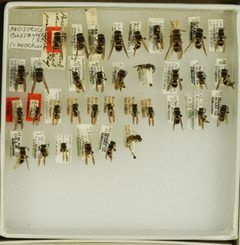
Ancistrocerus bustamente is a solitary mason wasp in the Eumeninae. Like other members of its , it constructs nests using mud and provisions them with paralyzed caterpillars for its larvae. The was described by de Saussure in 1857.

Pronunciation
How to pronounce Ancistrocerus bustamente: //ænˌsɪstroʊˈsɪərəs ˌbuːstəˈmænteɪ//
These audio files are automatically generated. While they are not always 100% accurate, they are a good starting point.
Identification
Members of the Ancistrocerus can be identified by a prominent transverse carina (ridge) on the base of the first abdominal segment (T1), creating an abrupt angle that the rear of the . This distinguishes Ancistrocerus from related genera where the slopes more gently toward the thorax.
Images
Diet
feed on nectar, honeydew, and other -rich liquids. Larvae are , feeding on paralyzed caterpillars provided by the female parent.
Life Cycle
Females construct solitary nests in pre-existing cavities such as hollow stems, borings in wood, or abandoned mud dauber nests. They partition cavities with mud to create individual , lay a single suspended from the cell roof by a silken thread, then provision the cell with multiple paralyzed caterpillars before sealing it with mud. The larva hatches, consumes the cached prey, spins a silken cocoon, and pupates within the cell.
Behavior
Females hunt caterpillars on foliage, sting them to induce paralysis, and transport them beneath the body to the nest. Some Ancistrocerus have been observed exploiting prey escape : running to one end of a leaf roll and vibrating the to entice the caterpillar to eject itself from its shelter.
Ecological Role
As a of caterpillars, this contributes to natural pest control in its . It also serves as a potential for including bee flies (Bombyliidae) and chalcidoid wasps.
Similar Taxa
- Ancistrocerus unifasciatusSimilar size range and general appearance; distinguished by having yellow markings primarily limited to one band on the (unifasciatus = 'one-banded') versus different patterning in A. bustamente
- Ancistrocerus campestrisOverlapping geographic range and use; A. campestris has yellow hind margins on the first three abdominal segments and may use different caterpillar as prey
- Ancistrocerus waldeniiSimilar nest construction using mud; A. waldenii constructs free-form mud nests attached to hard surfaces rather than using pre-existing cavities
More Details
Nesting biology
Based on documented of , A. bustamente likely exhibits the typical Ancistrocerus nesting strategy of using mud to partition pre-existing cavities into multiple , with each cell receiving one and several paralyzed caterpillars.
Taxonomic note
The specific epithet 'bustamente' is sometimes encountered as 'bustamante' in older literature, but 'bustamente' is the accepted spelling per the original description by de Saussure (1857).
Sources and further reading
- BugGuide
- GBIF taxonomy match
- iNaturalist taxon
- Catalogue of Life
- Bug Eric: Wasp Wednesday: Walden's Mason Wasp, Ancistrocerus waldenii
- Bug Eric: How to (Almost) Catch a Leaf-tier Caterpillar (Video)
- Bug Eric: How to Catch a Leafroller Caterpillar (Video)
- Bug Eric: Eight Illinois Wasp and Bee Mimics in Twenty Minutes
- Bug Eric: City Nature Challenge 2023 Recap