
Pterombrus rufiventris
Pterombrus rufiventris is a in the Thynnidae, native to North America. The is notable for its specialized as a of tiger (Cicindela) larvae. It is considered rare but has been documented across a wide geographic range from southern California to Texas and eastward to Georgia and Virginia. The species exhibits typical of thynnid wasps, with wingless females and winged males. Two are recognized: the nominate form in the eastern range and P. r. hyalinatus in the western portion of its distribution.
Pronunciation
How to pronounce Pterombrus rufiventris: /tɛˈrɒm.brəs ˌruː.fɪˈvɛn.trɪs/
These audio files are automatically generated. While they are not always 100% accurate, they are a good starting point.
Identification
Distinguished from other thynnid wasps by its black-and-red coloration and small, slender build. Most commonly confused with thread-waisted wasps (Sphecidae) or spider wasps (Pompilidae) due to similar ground-running and general body form. The wingless female condition separates it from many other . Within Thynnidae, it differs from the more common Myzinum in its color pattern and body proportions. Identification to level typically requires examination of collected specimens due to the rarity of the species and lack of comprehensive photographic references.
Images
Appearance
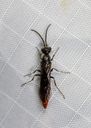
Small, slender approximately 20 mm in length. Body coloration is black and red. Females are wingless and exhibit a thread-waisted . Males possess wings. The overall body form resembles a fusion between thread-waisted wasps (Sphecidae) and spider wasps (Pompilidae) in general appearance.
Habitat
Occupies grassland and prairie , particularly shortgrass prairie. Associated with open, sparsely vegetated areas where tiger larvae construct their burrows. Documented from heavily-grazed shortgrass prairie at elevations typical of the Great Plains and similar open habitats across its range.
Distribution
North America, ranging from southern California to Texas and eastward to Georgia and Virginia. The western P. rufiventris hyalinatus occurs in the western portion of the range, while the nominate subspecies P. r. rufiventris occupies the eastern range. Documented from Colorado, Kansas, and other Great Plains states.
Seasonality
are active during summer months, with timed to coincide with monsoon rains in July in at least some portions of the range. The overwinters as a mature larva within a cocoon in the burrow, emerging the following summer.
Host Associations
- Cicindela obsoleta - larval known , specifically the larval stage
- Cicindela rufiventris - larval implied based on -level
- Cicindela - larval -level association for tiger larvae
Life Cycle
The female locates tiger larval burrows and crawls down the burrow to attack the larva. She stings the larva repeatedly under the or , then deposits a single on the 's . The mother wasp plugs the burrow with a compacted soil layer and fills the remainder with loose soil particles. The egg hatches in approximately 3 days. The wasp larva feeds on the paralyzed tiger beetle larva for approximately 9 days. The mature wasp larva detaches from the deceased and spins a cocoon within the burrow, where it overwinters. occurs the following summer, associated with seasonal rainfall patterns.
Behavior
Females are ground-active, running erratically between patches of grass while searching for burrows. They do not readily take when approached, showing tenacity in remaining at a location. The exhibits in males, with individuals perching on elevated points to locate mates. Mating occurs at these elevated perches.
Ecological Role
regulating of tiger beetles (Cicindela spp.), which are active in grassland . As a rare with specific associations, it contributes to the natural enemy complex of tiger populations. The 's activity patterns are linked to seasonal precipitation events, suggesting to semi-arid and prairie ecosystem dynamics.
Human Relevance
No direct economic importance. Of interest to entomologists studying - relationships and tiger . The has been documented in citizen science contexts and may serve as an indicator of intact grassland supporting healthy tiger beetle .
Similar Taxa
- Myzinum spp.Other common thynnid wasps, but differ markedly in appearance—Myzinum do not share the black-and-red slender body form of Pterombrus rufiventris
- Sphecidae (thread-waisted wasps)Similar ground-running and general body form, but possess wings in both sexes and are not of tiger larvae
- Pompilidae (spider wasps)Similar erratic running while hunting, but prey on spiders rather than tiger larvae and have different body proportions
More Details
Rarity and documentation
Considered very rare with few documented observations. As of 2017, no photographs existed online, and the was not represented in BugGuide. The first published images of the species may have been those taken by Eric Eaton in Colorado in 2017.
Taxonomic history
Originally described in Tiphiidae, now placed in Thynnidae based on phylogenetic revisions of the superfamily Vespoidea.
Subspecies distinction
The two recognized , P. r. rufiventris and P. r. hyalinatus, are primarily distinguished by geographic distribution rather than pronounced morphological differences.
Sources and further reading
- BugGuide
- iNaturalist taxon
- Bug Eric: Wasp Wednesday: Another Puzzler
- Eastern Red-Bellied Tiger Beetle | Beetles In The Bush
- August | 2010 | Beetles In The Bush | Page 2
- Buprestidae type specimens at Fundación Miguel Lillo, Argentina | Beetles In The Bush
- Collection Inventory update | Beetles In The Bush
- Eavesdropping Bees Encouraged by "Whispers," Deterred by "Shouts"