
Pterombrus
Smith, 1869
Species Guides
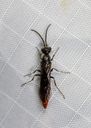
1Pterombrus is a of small, slender in the Thynnidae (formerly placed in Tiphiidae). The genus contains at least one described , Pterombrus rufiventris, which is a rare of tiger larvae. These wasps are poorly known and seldom photographed, with most biological knowledge derived from a single detailed study of the western P. rufiventris hyalinatus. are active during summer months and are associated with grassland where their occur.
Pronunciation
How to pronounce Pterombrus: /tɛˈrɒmbrʊs/
These audio files are automatically generated. While they are not always 100% accurate, they are a good starting point.
Identification
Pterombrus can be distinguished from the more common thynnid Myzinum by its more slender, less robust body form. It resembles thread-waisted wasps (Sphecidae) and spider wasps (Pompilidae) in general appearance and ground-running , but lacks the extremely elongated petiole of many sphecids and the more robust legs typical of pompilids. Identification to level requires examination of specimens; P. rufiventris is the only confirmed species in the genus with documented North American records. The two (P. r. rufiventris and P. r. hyalinatus) differ in geographic distribution and subtle morphological features.
Images
Habitat
Grassland and prairie , particularly shortgrass prairie with heavily grazed conditions. Associated with open, sandy or loose-soil areas where tiger larvae construct their burrows.
Distribution
North America, with records from southern California to Texas, and eastward to Georgia and Virginia. The western P. rufiventris hyalinatus occurs in the Great Plains and western states; the nominate subspecies P. r. rufiventris occupies the eastern portion of the range.
Seasonality
are active in summer, with peak timed to summer monsoon rains in July in at least some portions of the range. The overwinters as mature larvae in cocoons within burrows, emerging the following summer.
Host Associations
- Cicindela obsoleta - Large Grassland Tiger Beetle; larval stage is parasitized
- Cicindelinae - tiger larvae generally; specific range incompletely known
Life Cycle
The deposits a single on the of a tiger larva after stinging it repeatedly under the or . The egg hatches in approximately 3 days. The wasp larva feeds on the paralyzed for about 9 days. The mature larva then spins a cocoon within the host burrow and overwinters, emerging as an the following summer.
Behavior
run erratically between grass patches while searching for burrows; is rarely observed. The female enters host burrows to attack larvae, demonstrating specialized . After oviposition, the female plugs the burrow with a compacted soil layer and fills the remainder with loose soil particles, concealing the host from other and .
Ecological Role
Specialized of tiger larvae, regulating of these predatory beetles in grassland . Represents a rare but documented tri-trophic interaction linking , beetles, and the prey of tiger beetles.
Human Relevance
No direct economic or medical significance. Of interest to entomologists as a poorly known and rarely encountered . The species has been described as among the first photographed and published online, reflecting its rarity in collections and observations.
Similar Taxa
- MyzinumCommon in same (Thynnidae); Myzinum are more robust and larger, with different color patterns and associations
- Sphecidae (thread-waisted wasps)Similar slender body form and ground-running ; distinguished by more elongated petiole and different prey capture behavior
- Pompilidae (spider wasps)Similar size, coloration, and erratic running ; distinguished by more robust legs adapted for grappling with spiders and different use
More Details
Taxonomic placement
The has been transferred between ; historically placed in Tiphiidae, now recognized in Thynnidae. This reflects ongoing revision of higher-level relationships within the 'tiphioid' complex.
Rarity and documentation
Described as 'very rare but widely distributed' by . No photographs existed in major online repositories (BugGuide) prior to 2017. Most biological knowledge derives from a single 1989 study of the western in Kansas.
Host capture behavior
The must overcome the formidable defenses of tiger larvae, which possess large jaws and rapid strike capability. The repeated stinging under the or suggests a strategy to disable the larva's offensive capabilities before the wasp becomes vulnerable.