
Rhadinoceraea
Konow, 1886
iris sawfly
Species Guides
2Rhadinoceraea is a of in the Tenthredinidae, tribe Phymatocerini. in this genus are herbivorous and exhibit specialized associations with plants in the orders Liliales and Ranunculales. Some species are notable for sequestering defensive compounds from their host plants. The genus includes recognized species such as R. micans, a garden pest of irises, and R. nodicornis, which feeds on Veratrum and shows strict innate host specificity.
Pronunciation
How to pronounce Rhadinoceraea: //ræˌdɪnəsɪˈriə//
These audio files are automatically generated. While they are not always 100% accurate, they are a good starting point.
Identification
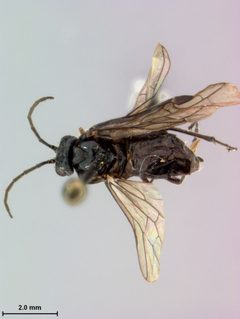
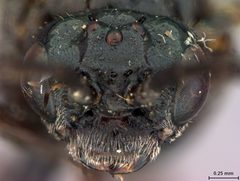
distinguished by thick longer than and combined, shiny black coloration, and smoky wings. Larvae distinguished from caterpillars by having six pairs of rather than five; from other larvae by the combination of shiny black head, greenish-brown body with darkening in older individuals, and double rows of white dots around segments. plant association provides additional diagnostic information: R. micans on waterside irises, R. nodicornis on Veratrum .
Images
Habitat
Associated with plants in moist or waterside environments. R. micans occurs specifically where waterside irises grow; larvae do not attack irises on dry ground. R. nodicornis associated with Veratrum .
Distribution
Europe. R. micans recorded from Britain, France, Sweden, Finland, Denmark, Netherlands, Germany, Poland, Italy, Bulgaria, and Romania; absent from Spain, Sicily, Mediterranean islands, Greece, former Yugoslavia, and countries east of Poland. GBIF records indicate presence in Denmark, Norway, and Sweden.
Seasonality
active in May. Larvae present from May through approximately July, after which they enter soil to pupate and overwinter. Adults emerge the following May.
Diet
Herbivorous; larvae feed on specific plants. R. micans larvae feed on waterside irises including Iris pseudacorus, I. ensata, I. laevigata, I. spuria, and I. versicolor. R. nodicornis larvae feed exclusively on Veratrum (Liliales: Melanthiaceae).
Host Associations
- Iris pseudacorus - larval primary ; yellow flag iris
- Iris ensata - larval
- Iris laevigata - larval
- Iris spuria - larval
- Iris versicolor - larval
- Veratrum nigrum - larval R. nodicornis; source of steroid alkaloids
- Veratrum species - larval R. nodicornis; Liliales: Melanthiaceae
Life Cycle
laid in May on plant leaves in large flat placards; female inserts eggs into leaf blade near thickened middle, close to leaf base, up to 19 eggs per leaf. Larvae feed on leaves until approximately July, then crawl into ground, spin cocoons, and pupate. Overwinters as pupae. emerge the following May. .
Behavior
fly reluctantly and may feign death when touched. Larvae of R. nodicornis exhibit strict innate specificity, accepting only Veratrum regardless of early experience. R. micans larvae can occur in large .
Ecological Role
Herbivore; some sequester defensive compounds from plants (steroid alkaloids in R. nodicornis from Veratrum; iridoid glycosides have been reported in related contexts). These compounds provide chemical defense against .
Human Relevance
R. micans is a serious garden pest that can completely defoliate ornamental irises, particularly yellow iris (Iris pseudacorus) growing by water. Irises on dry ground are not attacked. The is more frequently noticed as larvae than as .
Similar Taxa
- Other Tenthredinidae sawfliesLarvae distinguished by six pairs of (vs. five in caterpillars) and specific coloration patterns; distinguished by longer than and combined.
- Other PhymatoceriniClose relatives share associations with Liliales and Ranunculales; distinguished by specific host plant associations and, where known, chemical defense profiles.
More Details
Chemical defense
R. nodicornis sequesters steroid alkaloids from Veratrum plants and uses them for defense against . These alkaloids are phagostimulatory for larvae and may be involved in host recognition, representing a potential mechanism for host radiation within the Phymatocerini.
Host recognition
In R. nodicornis, specificity is innate and independent of early larval experience. females use visual and chemical cues for host recognition.
Sources and further reading
- BugGuide
- Wikipedia
- GBIF taxonomy match
- iNaturalist taxon
- NCBI Taxonomy
- Host specificity and host recognition in a chemically-defended herbivore, the tenthredinid sawfly Rhadinoceraea nodicornis
- Host specificity and host recognition in a chemically‐defended herbivore, the tenthredinid sawfly Rhadinoceraea nodicornis