
Sceliphron curvatum
(F. Smith, 1870)
Asian mud-dauber wasp
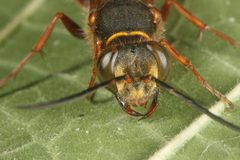
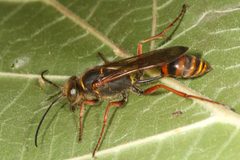
Sceliphron curvatum is a solitary mud-daubing native to Central Asia that has become in Europe and North America. First recorded in Europe in 1979, it has since expanded across multiple European countries and was first documented in North America in 2013. The is smaller and darker than the native North American Sceliphron caementarium, with a body length of 15–25 mm and black coloration with yellow and red ornaments. It exhibits strongly , frequently nesting indoors on clothing, books, and furniture rather than exclusively on building exteriors.

Pronunciation
How to pronounce Sceliphron curvatum: /scɛˈlɪfrɒn ˈkɜːrvətəm/
These audio files are automatically generated. While they are not always 100% accurate, they are a good starting point.
Identification
Distinguished from the native black and yellow mud dauber (Sceliphron caementarium) by its smaller size (15–25 mm vs. 24–28 mm) and darker coloration with reduced yellow markings. From the blue mud dauber (Chalybion spp.) by its stockier build and different abdominal shape. Indoor nesting on clothing, books, and furniture is highly characteristic and not typical of native North American mud daubers. Nests are mud constructions of 3–56 attached to various substrates. Specimens may be confused with S. deforme; the two Asian are reportedly difficult to distinguish morphologically.
Images
Habitat
Strongly ; primarily associated with human-modified environments. In its native range, found in submontaneous regions of major Asian mountain ranges. In invaded regions, nests predominantly inside buildings including attics, flats, bathrooms, kitchens, and storage areas. Nests built in concealed locations such as clothing, cardboard boxes, curtain rails, window frames, shelves, under bags, and between rafters. Occasionally found in meadows near buildings. Requires nearby source of mud for nest construction. Nests are not rain-, explaining preference for sheltered environments.
Distribution
Native to Central Asia: India, Nepal, Pakistan, Kazakhstan, and Tajikistan in the foothills of the Himalayas, Karakoram, and Pamir mountain ranges. Introduced to Europe: first recorded in Austria in 1979, subsequently spreading to Slovenia, Italy, Croatia, Switzerland, France, Hungary, Germany, Serbia, Montenegro, Greece, Czech Republic, Spain, Slovakia, Ukraine, Portugal, Poland, Romania, Belgium, Bulgaria, and Cyprus. Introduced to North America: first confirmed record in Colorado Springs, USA in 2014 (first North American record from Montreal, Canada in 2013). Also reported from Argentina (2008). Rapidly expanding range in all invaded regions through active and likely passive transport.
Seasonality
most common during the growing season. In North America, active from spring through autumn; observed gathering mud in October in Colorado. Breeding present year-round and persist for years after abandonment. Protandric: males emerge before females.
Diet
observed drinking nectar on flowers of Apiaceae (Umbelliferae). Larvae provisioned with paralyzed spiders—typical for Sceliphron, though specific prey for S. curvatum not documented in available sources.
Life Cycle
Solitary breeding; no colony. Females construct mud nests containing 3–56 breeding (most commonly small numbers, though one nest observed with 26 cells expanded to 56 cells over two years). Each cell provisioned with multiple paralyzed spiders, followed by deposition of single and mud partition. Larva consumes cached spiders, pupates within cell, and chews exit hole. Development time not precisely documented; likely single per year in temperate regions with as pupa or adult in protected indoor sites.
Behavior
Strongly with pronounced preference for concealed indoor nesting sites, unlike the native S. caementarium which typically nests on building exteriors. Females visit building interiors for nesting while males rarely observed. Nests hidden in remote attic areas, clothing, and boxes, making detection dependent on accidental discovery. Potential for passive via transport of clothing or objects containing nests. Not aggressive unless threatened; sting mild compared to social , designed for prey paralysis rather than defense.
Ecological Role
of spiders; may impact local spider in invaded regions. As , occupies human-modified with minimal apparent competition with native mud daubers where ranges overlap. Rapid colonizer expanding range through active and passive transport via human commerce.
Human Relevance
Considered in Europe and North America; first U.S. record considered significant enough to warrant reporting to state agriculture departments. Indoor nesting habits may cause nuisance in homes and storage areas. Not dangerous to humans—sting mild and not aggressive. Potential for unintentional transport via international commerce, particularly through nesting in clothing, books, and shipped goods. No known economic damage; primarily of interest as example of insect invasion dynamics.
Similar Taxa
- Sceliphron caementariumNative North American black and yellow mud dauber; larger (24–28 mm), brighter yellow markings, nests predominantly on building exteriors rather than indoors.
- Sceliphron deformeAnother Asian reportedly difficult to distinguish morphologically from S. curvatum; may represent identification challenge where both occur.
- Chalybion spp.Blue mud daubers; similar size and dark coloration but more slender build, different abdominal shape, and use pre-existing cavities or take over S. caementarium nests rather than build own mud nests.
More Details
Invasion History
First European record 1979 in southeastern Austria, likely introduced via human activity. Spread throughout Europe primarily through natural , reaching Poland by 2007. First North American record July 2013 from Montreal, Canada; first U.S. record April 2014 from Colorado Springs, Colorado. Second Colorado record October 2014 from Quail Lake Park, with observed actively gathering mud, indicating established .
Taxonomic Note
Originally described as Pelopaeus curvatus by F. Smith in 1870; transferred to Sceliphron. placement as Sphecidae follows traditional classification; some modern treatments place Sceliphron in family Sceliphridae or expanded Sphecidae sensu lato.
Sources and further reading
- BugGuide
- Wikipedia
- GBIF taxonomy match
- iNaturalist taxon
- NCBI Taxonomy
- Catalogue of Life
- Bug Eric: Exclusive! Important Wasp BOLO
- Bug Eric: October 2014
- Bug Eric: Pipe Organ Mud Dauber, Trypoxylon politum, Found in Colorado
- Bug Eric: August 2015
- Where have all the spiders gone? Black and yellow mud dauber wasps, Sceliphron caementarium — Bug of the Week
- From the mailbag – Mud daubers and humans partner to create unique pottery: Black and yellow mud dauber wasps, Sceliphron caementarium — Bug of the Week
- Distribution of Sceliphron curvatum Smith, 1870 (Hymenoptera, Sphecidae) in Poland
- Distribution and a New Locality Record of the Invasive Asian Wasp, Sceliphron curvatum (F. Smith, 1870) (Hymenoptera: Sphecidae) in Europe and Turkey