
Ammophila juncea
Cresson, 1865
Ammophila juncea is a of thread-waisted wasp in the Sphecidae. It belongs to a diverse of solitary hunting known for provisioning nests with paralyzed caterpillars. Like other Ammophila species, females construct burrows in sandy soil and provide paralyzed prey for their larval offspring. The species was described by Cresson in 1865 and occurs in North and Middle America.
Pronunciation
How to pronounce Ammophila juncea: /ˌæməˈfaɪlə ˈdʒʌnsia/
These audio files are automatically generated. While they are not always 100% accurate, they are a good starting point.
Images
Habitat
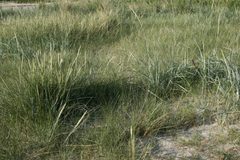
Open areas with sandy soil are favored nesting sites for many Ammophila . The is associated with compact sand substrates suitable for burrow excavation.
Distribution
North America; Middle America. GBIF records indicate presence in both regions.
Behavior
Females of the Ammophila are known to construct burrows in sandy soil, capture and paralyze caterpillars, and provision nests for their offspring. They have been observed to cover burrow entrances and perform orientation to relocate nests. Some Ammophila can fly with prey oriented beneath the body for maximum aerodynamic .
Similar Taxa
- Ammophila proceraLarger (25-38 mm) with distinctive silver stripes on sides; A. juncea likely smaller and may lack or have reduced thoracic striping
- Ammophila wrightiiAnother Ammophila recorded as caterpillar hunter in same geographic region
- Ammophila arenariaDifferent of dune-building grass, not a ; potential source of naming confusion
More Details
Taxonomic note
The specific epithet 'juncea' (Latin for 'rush-like') may refer to the slender, thread-waisted appearance characteristic of the . The name has been confused with Elytrigia juncea (syn. Elytrichia juncea), a dune-building grass species studied in coastal literature.
Research context
Specimens of Ammophila juncea have been studied in relation to Strepsiptera . The Ammophila serves as for twisted-wing parasites, with maternal care potentially increasing risk of transmission to offspring.
Sources and further reading
- BugGuide
- Wikipedia
- GBIF taxonomy match
- iNaturalist taxon
- Catalogue of Life
- 'When I Grow Up, I Want to Be an Entomologist' | Bug Squad
- Humbled and Honored to Receive ACE Awards | Bug Squad
- RJ Millena: from Entomology-Focused Kindergartener to Scoring Cover of Journal With Her Research | Bug Squad
- Bug Eric: June 2012
- Bug Eric: Wasp Wednesday: Ammophila procera
- Bug Eric: Ammophila in Action
- Does salt stress constrain spatial distribution of dune building grasses Ammophila arenaria and Elytrichia juncea on the beach?