
Vanhorniidae
Crawford, 1909
Genus Guides
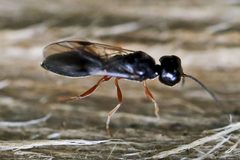
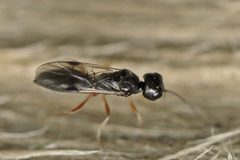
1is a small of in the superfamily Proctotrupoidea, containing the single Vanhornia with six recognized worldwide. The family is characterized by highly specialized including exodont , low antennal insertion, and an exceptionally long ovipositor that projects anteriorly from its base and is housed in a groove. Species are koinobiont endoparasitoids of wood-boring larvae in the family Eucnemidae (false click beetles). The North American species Vanhornia eucnemidarum was long considered rare due to limited collection records, but recent data integration revealed a much broader distribution than previously recognized.
Pronunciation
How to pronounce Vanhorniidae: /vænˈhɔrn.i.aɪ.iːd/
These audio files are automatically generated. While they are not always 100% accurate, they are a good starting point.
Identification
Distinguished from other Proctotrupoidea by the anteriorly projecting ovipositor (projecting forward from base rather than posteriorly), exodont , and deeply pitted mesosomal . The single Vanhornia contains six separable by geographic distribution and subtle morphological differences; species-level identification requires reference to specialized keys.
Images
Habitat
Forest , particularly stands of deciduous trees including maple. Associated with dead and rotting wood where larvae develop. Presence linked to saproxylic (wood-decaying) conditions supporting Eucnemidae .
Distribution
Holarctic distribution with extensions into East Asia. North America: widespread across eastern and central United States and southern Canada, with records from Connecticut, Florida, Georgia, Kansas, Kentucky, Maine, Maryland, Michigan, Mississippi, Missouri, New Hampshire, New Jersey, New York, North Carolina, Ohio, Oregon, South Carolina, Tennessee, Texas, Virginia, West Virginia, Wisconsin, and Canadian provinces of Manitoba, Ontario, Quebec. Europe: Sweden, France, Germany, Netherlands, Switzerland, Russian Far East. Asia: Taiwan, Japan, Laos, South Korea.
Host Associations
- Eucnemidae - koinobiont endoparasitoidLarvae of false click beetles, specifically Isorhipis ruficornis in North America
Behavior
Koinobiont endoparasitoid of holometabolous insect larvae. The long, anteriorly directed ovipositor is adapted for reaching larvae in wood galleries. development occurs within living host larvae, allowing host to continue feeding and growing before eventual death.
Ecological Role
agent of wood-boring larvae in forest . appear tied to beetle rarity, contributing to apparent scarcity of the themselves.
Human Relevance
Potential value as agent for wood-boring pests. Historical rarity in collections led to underestimation of actual distribution; improved data integration reveals wider presence than previously recognized.
Similar Taxa
- ProctotrupidaeAlso Proctotrupoidea with compact bodies and , but lack anteriorly projecting ovipositor and have different mandibular structure
- HeloridaeRelated proctotrupoid , but of Neuroptera rather than Coleoptera and lack the distinctive ovipositor groove
- RoproniidaeRelated proctotrupoid with different body proportions and associations
More Details
Taxonomic history
The was long considered or nearly so, with Vanhornia eucnemidarum as the only well-known . Recent revisionary work recognized six species worldwide, with two new species described from Taiwan and Japan in 2021. The South Korean record of V. eucnemidarum was invalidated, with Asian records reassigned to other species.
Collection bias
Historical rarity in collections appears artifactual, resulting from specialized (dead wood), small size, lack of recognition by non-, and limited targeted sampling. Integration of museum records, personal collections, and citizen science data greatly expanded known range of V. eucnemidarum.
Sources and further reading
- BugGuide
- GBIF taxonomy match
- iNaturalist taxon
- NCBI Taxonomy
- Catalogue of Life
- Présence en France de Vanhornia leileri Hedqvist, 1976 (Hymenoptera, Proctotrupoidea, Vanhorniidae)
- Review of the family Vanhorniidae (Hymenoptera: Proctotrupoidea), with the description of two new species
- Integrating multiple sources of biodiversity information greatly expands the range of a rare species of Hymenoptera (Vanhorniidae)
- Biology, ecology, and taxonomy of the parasitoids of the families of Austroniidae, Peradeniidae, Proctorenyxidae, Roproniidae, and Vanhorniidae (Hymenoptera: Proctotrupoidea)
- Biology, ecology, and taxonomy of the parasitoids of the families Austroniidae, Peradeniidae, Proctorenyxidae, Roproniidae, and Vanhorniidae (Hymenoptera: Proctotrupoidea) and family Mymarommatidae (Hymenoptera: Proctotrupomorpha: Mymarommatoidea)