
Heloridae
Genus Guides
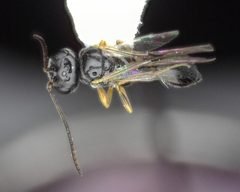
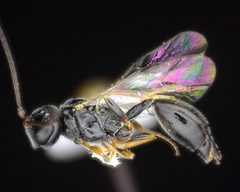
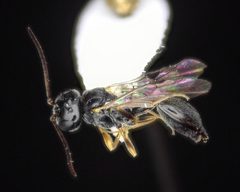
1is a of parasitic in the superfamily Proctotrupoidea. The family is represented by a single extant , Helorus, with approximately 12-18 distributed worldwide. Extant members are solitary endoparasitoids of Chrysopidae (green lacewing) larvae. The family is notable for its extensive fossil record, with numerous extinct genera documented from Jurassic and Cretaceous deposits in Asia and Europe.
Pronunciation
How to pronounce Heloridae: //hɛˈlɔrɪˌdiː//
These audio files are automatically generated. While they are not always 100% accurate, they are a good starting point.
Identification
Extant are small, slender . -level identification within Helorus requires examination of morphological characters including antennal structure, wing venation, and body coloration patterns. has been successfully applied to distinguish European species, though not all species are represented in reference databases.
Images
Distribution
Worldwide. Documented from Europe (including Denmark, Norway, Sweden, Turkey), Central America (Honduras, Guatemala), and other regions. Fossil are known from Middle Jurassic to Early Cretaceous deposits in China, Russia, Kazakhstan, Mongolia, South Korea, and North Korea.
Host Associations
- Chrysopidae - endoparasitoidlarval stage of green lacewings
Life Cycle
Solitary endoparasitoids that develop inside larvae. The uses the cocoon constructed by the host chrysopid larva to complete its own pupal development.
Behavior
Solitary ; females locate and parasitize larvae.
Ecological Role
agent of green lacewing .
Similar Taxa
- DrynidaeBoth are of parasitic in Proctotrupoidea, but Drynidae are ectoparasitoids of Hemiptera (leafhoppers, planthoppers) rather than endoparasitoids of Neuroptera.
- IsmaridaeRelated proctotrupoid , but Ismaridae are of Hemiptera (cicadas) or hyperparasitoids of Drynidae, not parasitoids of Chrysopidae.
More Details
Fossil Record
has an exceptionally rich fossil record compared to its extant diversity. Over 10 extinct are documented from the Middle Jurassic (Callovian) through Early Cretaceous (Aptian-Albian), primarily from lacustrine deposits in northeastern China (Yixian, Laiyang, Jinju formations) and Transbaikalia (Turga, Russia). This fossil diversity contrasts sharply with the single surviving genus Helorus.
Sources and further reading
- BugGuide
- Wikipedia
- GBIF taxonomy match
- iNaturalist taxon
- NCBI Taxonomy
- Catalogue of Life
- Studies on the families Drynidae, Heloridae and Ismaridae (Insecta: Hymenoptera)
- SYSTEMATIC REVIEW OF THE BIOLOGICAL CHARACTERISTICS OF THE HELORIDAE FAMILY (INSECTA: HYMENOPTERA)
- Discovery of Helorus brethesi Oglobin, 1928 (Hymenoptera, Heloridae) in Honduras and Guatemala
- New evidence on the identity of the European Helorus species (Hymenoptera, Proctotrupoidea, Heloridae)
- A Remarkable Record of Little-Known Parasitoid Wasp Helorus striolatus (Hymenoptera: Heloridae) from Türkiye with A Global Checklist of the this Family