
Sapyga centrata
Say, 1836
Sapyga centrata is a small, solitary in the Sapygidae, a group of cleptoparasitic wasps that exploit the nests of other solitary bees. The is characterized by a compact black body with yellow or white markings and a distinctive clubbed . It is native to North America and has been documented across a broad geographic range. As a , it does not construct its own nest or provision food for its offspring, instead laying in the nests of bees.
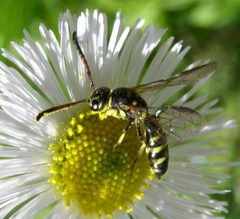
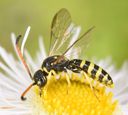
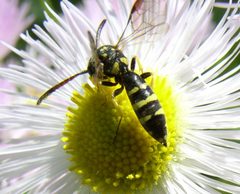
Pronunciation
How to pronounce Sapyga centrata: /səˈpɪɡə sɛnˈtreɪtə/
These audio files are automatically generated. While they are not always 100% accurate, they are a good starting point.
Identification
Distinguished from similar small black-and-yellow by the clubbed (expanded terminal segments), which are unique to Sapygidae among North American Hymenoptera. Separated from by specific pattern of pale markings: S. centrata typically shows a transverse pale band on the margin of the first abdominal and paired spots on subsequent terga. Distinguished from cleptoparasitic bees (e.g., Nomada) by the wasp-waisted petiole and less hairy, more strongly sculptured . Can be confused with chrysidid wasps, but chrysidids have a more strongly sculptured, often metallic and lack clubbed antennae.
Images
Appearance
Small to medium-sized , approximately 5–10 mm in length. Body predominantly black with contrasting yellow or white markings on the , , and abdominal segments. distinctly clubbed at the tips, a diagnostic feature of the Sapygidae. Wings clear to slightly smoky with reduced venation. Body moderately hairy, less densely so than most bees. somewhat flattened dorsoventrally. Legs relatively short and stout.
Habitat
Open including meadows, prairies, forest edges, and anthropogenic environments such as gardens and parks. Associated with areas supporting of its bees, particularly cavity-nesting bees that nest in pre-existing holes in wood or hollow stems. Often found near wooden structures, fence posts, and dead wood that provide nesting substrates for hosts.
Distribution
Widespread in North America, recorded from southern Canada through the United States to northern Mexico. Documented across the eastern and central United States, with records extending westward to the Great Plains. Specific state and provincial records include Ontario, Quebec, and numerous states from the Atlantic seaboard to the Midwest.
Seasonality
active primarily from late spring through summer, with peak activity typically occurring June through August in northern portions of the range. Activity period coincides with the nesting season of its bees. timing may vary geographically and with local climate conditions.
Host Associations
- Megachile - Cavity-nesting leafcutter bees; S. centrata lays in provisioned nest
- Osmia - Mason bees nesting in pre-existing cavities; documented
- Hoplitis - Mason bees; some reported as
Life Cycle
Cleptoparasitic; females locate completed or partially provisioned nest of bees. is laid into the host cell, typically on or near the host egg or young larva. Sapyga larva consumes the host egg or larva and then feeds on the pollen-nectar provision. Development proceeds through larval instars, , and , with timing synchronized to host . Typically , with one per year, though this may vary with host availability and latitude.
Behavior
Females actively search for nests by investigating cavities in wood, stems, and other substrates. Searching involves repeated inspection of potential nest entrances, sometimes entering to assess contents. Males patrol nesting areas to locate receptive females. have been observed visiting flowers, likely for nectar, though this behavior is less frequent than in host bees. No nest construction or prey capture behavior; all depends on locating and exploiting host nests.
Ecological Role
Acts as a (nest ) on solitary bees, regulating and potentially influencing structure. By parasitizing cavity-nesting bees, it contributes to mortality factors affecting populations. Serves as prey for various including birds and other insects. May indirectly affect plant pollination by reducing local bee densities, though this impact is generally minor at landscape .
Human Relevance
Occasionally encountered in nesting blocks and artificial bee hotels deployed for conservation, where it may be perceived as a pest due to of desirable mason and leafcutter bees. No direct economic importance; not known to sting humans aggressively. Presence in bee nesting can indicate functional processes, including adequate bee .
Similar Taxa
- Sapyga pumilaOverlapping distribution and similar color pattern; distinguished by details of abdominal pale markings and male genitalia
- Sapyga quinquepunctataSimilar size and coloration; S. centrata typically has more extensive pale markings on the first abdominal
- NomadaCleptoparasitic bees with similar black-and-yellow coloration; distinguished by branched body hairs, rounded without club, and -like overall
- ChrysididaeCleptoparasitic with compact bodies; distinguished by metallic coloration (often blue or green), heavily sculptured , and thread-like without club
More Details
Taxonomic history
Described by Thomas Say in 1836, among the earliest North American insects to receive formal scientific description. The specific epithet 'centrata' refers to the central or pale markings on the . Sapygidae was long considered a of Mutillidae (velvet ants) due to superficial similarities, but is now recognized as a distinct within the superfamily Pompiloidea or as incertae sedis within depending on classification system.
Conservation status
Not evaluated by IUCN; considered secure given broad distribution and associations. Local may fluctuate with host availability; vulnerable to practices that reduce cavity-nesting bee , such as removal of dead wood and wooden debris.