
Sapyga
Latreille, 1796
Species Guides
5- Sapyga angustata
- Sapyga centrata
- Sapyga confluenta
- Sapyga louisi(Louis's Club-horned Cuckoo Wasp)
- Sapyga martinii
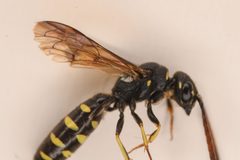
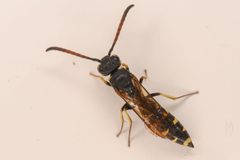
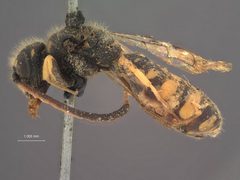
Sapyga is a of sapygid comprising at least 19 described . Species in this genus are (kleptoparasites) of solitary bees, particularly megachilid bees. They enter nests to lay in unfinished or provisioned , with their larvae consuming host provisions and killing host larvae. The genus exhibits specialized parasitic adaptations including the ability to oviposit through cell closures.
Pronunciation
How to pronounce Sapyga: /səˈpɪɡə/
These audio files are automatically generated. While they are not always 100% accurate, they are a good starting point.
Identification
Sapyga are distinguished from other sapygid by features of the Sapygidae combined with genus-level characteristics. Members of the family typically have a slender body form, reduced wing venation with a distinct stigma, and often exhibit spotted or banded color patterns on the . Species-level identification requires examination of morphological characters such as punctation patterns, coloration details, and genitalia structure.
Images
Habitat
Associated with nests of solitary bees; specific microhabitats include reed tubes, hollow stems, and artificial nesting materials used by bees. In northern China, S. coma has been documented inside thick reeds.
Distribution
Documented from Europe (Denmark, Norway, Sweden), North America (United States, specifically Vermont), and Asia (China, specifically the Jiaodong Peninsula district of Shandong Province). Distribution likely follows that of .
Seasonality
are active during the nesting period of bees. In northern China, S. coma enters as non-emerged adults from September through March, with in spring.
Diet
Larvae consume pollen and nectar provisions stored by bees; S. luteomaculata exhibits hospicidal , actively killing host larvae in addition to consuming provisions.
Host Associations
- Chelostoma florisomne - nest Sapyga clavicornis parasitizes this megachilid ; empty in nests reduce success
- Osmia excavata - Sapyga coma lays in unfinished ; larvae kill larvae
- Megachilidae - -level association for
Life Cycle
One per year in documented . enter as non-emerged adults inside cocoons for periods of approximately 7 months in temperate regions. Larvae develop within , consuming provisions and killing host offspring.
Behavior
Females enter nests during host provisioning periods to oviposit. S. clavicornis has been observed ovipositing through closures, with deposited in this manner not detected or removed by host bees. offspring may become trapped in empty cells constructed by hosts as a defensive strategy, resulting in starvation. Intraspecific interference competition occurs among parasite offspring within cells. Supercooling points and physiological parameters (fresh weight, fat content) correlate positively with those of host bees in S. coma.
Ecological Role
and of solitary bees, contributing to top-down of . Empty constructed by bees as defense against these may represent an evolutionary arms race between host and parasite.
Human Relevance
Similar Taxa
- Other Sapygidae genera members share cleptoparasitic lifestyle on bees; Sapyga distinguished by -specific morphological characters and associations primarily with Megachilidae
- MelittobiaAlso parasitizes bees but belongs to Eulophidae; differs in being an ectoparasitoid with different and much smaller size
- CoelopencyrtusParasitizes and larvae but is a chalcid with different and rather than cleptoparasitic strategy
Sources and further reading
- BugGuide
- Wikipedia
- GBIF taxonomy match
- iNaturalist taxon
- NCBI Taxonomy
- Hospicidal Behavior of the Cleptoparasitic Wasp Sapyga luteomaculata And Investigation into Ontogenetic Changes in Its Larval Anatomy (Hymenoptera: Vespoidea: Sapygidae)
- Interaction between the solitary bee Chelostoma florisomne and its nest parasite Sapyga clavicornis − empty cells reduce the impact of parasites
- The Supercooling Responses of the Solitary Bee Osmia excavata (Hymenoptera: Megachilidae) under the Biological Stress of Its Brood Parasite, Sapyga coma (Hymenoptera: Sapygidae).