
Hoplitis
Klug, 1807
Small Mason Bees
Species Guides
13- Hoplitis albifrons(White-fronted Small-Mason)
- Hoplitis anthocopoides(Viper's Bugloss Small-Mason)
- Hoplitis biscutellae(Creosote Small-Mason)
- Hoplitis bullifacies
- Hoplitis bunocephala
- Hoplitis elongaticeps
- Hoplitis fulgida(Green Small-Mason)
- Hoplitis howardi
- Hoplitis hypocrita(Mimic Small-Mason)
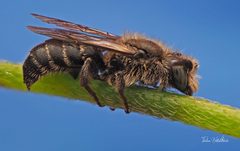
Hoplitis is a large of solitary bees in the Megachilidae, tribe Osmiini, comprising over 380 described distributed primarily across the Palaearctic region. These bees are commonly known as small mason bees and exhibit diverse nesting strategies including burrows in soil, pre-existing cavities in wood or stone, and insect borings in dead wood. Many species are pollen (oligolectic), with documented associations to specific plant genera including Allium, Reseda, Astragalus, Onosma, and others. The genus demonstrates remarkable biogeographic patterns, including disjunct distributions spanning thousands of kilometers between European and Central Asian .
Pronunciation
How to pronounce Hoplitis: //hɒˈplaɪtɪs//
These audio files are automatically generated. While they are not always 100% accurate, they are a good starting point.
Identification
Distinguished from other osmiine by combination of: (1) scopa present (vs. absent in some related genera), (2) specific genitalic and sternal structures in males, (3) often metallic coloration, and (4) nesting involving use of mud, leaf pieces, or soil in cavity construction. Subgenera are distinguished by morphological characters including shape, punctation patterns, and male genitalia. Identification to level requires examination of microscopic characters and often knowledge of geographic origin and plant associations. Molecular phylogenetic studies have clarified relationships among subgenera and species groups.
Images
Appearance
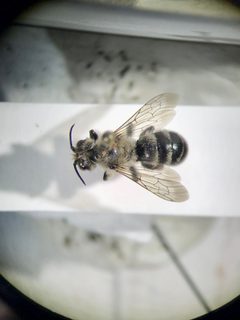
Small to medium-sized bees, typically 5-15 mm in length. Body form varies from slender to moderately robust. Many exhibit metallic coloration, including green, blue, or bronze tints, particularly in males. often with punctate sculpturing. Females carry pollen on the scopa (abdominal pollen brush), characteristic of Megachilidae. Males frequently possess modified facial structures and may show distinct color patterns on the and . Some species have unusually long adapted for accessing nectar from long-tubed flowers.
Habitat
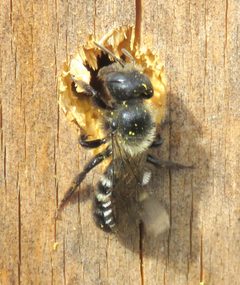
Diverse ranging from Mediterranean scrub and alpine steppe to desert and semidesert environments. Many occupy open, sun-exposed areas with bare soil or rocky substrates suitable for nesting. Alpine and subalpine meadows numerous species. Some subgenera are specifically adapted to arid environments including deserts from southern Spain to eastern Asia and the Gobi desert. Nesting substrates include vertical clay cliffs, horizontal soil surfaces, dead wood with insect borings, hollow stems, and cavities in stones or rocks.
Distribution
Primarily Palaearctic distribution, with greatest diversity in the Mediterranean region, Central Asia, and the Middle East. Documented from Europe (including Scandinavia), North Africa, Asia Minor, Central Asia, and extending to eastern Asia. Some exhibit highly disjunct distributions, such as Hoplitis onosmaevae occurring in both the French Alps and mountainous regions of Turkey and northern Iraq, separated by over 2000 km. North American records exist but require verification; some may represent misidentifications or introduced .
Seasonality
activity periods vary by and latitude. Most species are (one per year), with adults active from spring through summer depending on elevation and local climate. Prepupal occurs during winter months. In alpine and Mediterranean regions, periods are typically condensed into warmer months. Some desert-adapted species may show activity patterns tied to ephemeral flowering of plants.
Host Associations
- Allium - pollen Subgenus Chlidoplitis
- Astragalus - pollen H. astragali and related
- Reseda - pollen Multiple subgenera including Platosmia
- Onosma - pollen H. onosmaevae; also nectar source
- Haplophyllum - pollen Subgenus Chlidoplitis
- Teucrium - pollen Subgenus Chlidoplitis
- Trifolium - pollen Subgenus Chlidoplitis
- Hedysareae - pollen Subgenus Chlidoplitis
- Carduoideae - pollen Subgenus Megahoplitis
- Frankenia - pollen Subgenus Stenosmia; desert
- Peganum - pollen Subgenus Stenosmia
- Tamarix - pollen Subgenus Stenosmia
- Zygophyllum - pollen Subgenus Stenosmia
Life Cycle
Solitary bees with complete . Nests typically contain 1-3 arranged linearly in excavated burrows or pre-existing cavities. Females construct cells using various materials: mud, chewed leaves, or soil depending on . Each cell receives a spherical or ovoid pollen-nectar provision, upon which a single is deposited. Larvae consume the provision and spin a cocoon for . One per year; enter and overwinter. Some species have been observed to buzz flowers during pollen collection—a rare in Megachilidae. Kleptoparasites including Sapyga species have been recorded in nests.
Behavior
Solitary nesting with no social cooperation beyond mating. Females independently construct and provision nests. Males often aggregate near nesting sites, creating apparent swarms as they search for mates. Nesting substrate selection is -specific: some excavate burrows in clay or soil, others utilize pre-existing cavities in wood, stone, or old insect burrows. Nest architecture includes entrance plugs, vestibules, and partitions constructed from gathered materials. Foraging behavior includes both nectar and pollen collection, with many species exhibiting oligolecty (specialization on limited plant ). Some species demonstrate flower-buzzing behavior for pollen release.
Ecological Role
Important in diverse , particularly in Mediterranean, alpine, and arid environments where they often represent significant components of the fauna. Oligolectic maintain specialized plant-pollinator relationships with their plants. Nest excavation contributes to soil bioturbation and aeration. As prey for kleptoparasitic bees and , they support higher . Their presence indicates quality in open, sun-exposed landscapes with appropriate nesting substrates and floral resources.
Human Relevance
Potential value as in natural and agricultural , though less studied than honey bees or bumblebees. Some may contribute to pollination of crops in Mediterranean and Central Asian regions. conservation for Hoplitis species aligns with broader goals of preserving pollinator diversity and open habitat ecosystems. No documented negative impacts; stinging is rare and mild due to small size and solitary nature.
Similar Taxa
- OsmiaSimilar size, metallic coloration, and nesting in pre-existing cavities; distinguished by differences in scopa structure, male genitalia, and often by nest materials used (Osmia typically uses chewed leaf pulp or mud, Hoplitis shows more diverse materials)
- MegachileShared Megachilidae with scopa; Megachile typically uses leaf pieces for construction and has broader plant range, while Hoplitis often uses mud or soil and shows greater pollen specialization
- HeriadesSimilar small size and cavity-nesting habit; Heriades typically uses resin as primary nest material and has different body proportions and male genitalic structures
- ChelostomaRelated osmiine with similar overall form; distinguished by structure, scopa characteristics, and often more specialized plant associations
More Details
Taxonomic complexity
The comprises multiple subgenera (Hoplitis s.str., Chlidoplitis, Megahoplitis, Stenosmia, Platosmia, and others) with distinct ecological and morphological characteristics. Recent molecular phylogenetic studies have clarified relationships but also revealed in nesting .
Biogeographic disjunctions
Several exhibit extreme disjunct distributions between western Europe and Central Asia, suggesting historical climate fluctuations or long-distance . Hoplitis onosmaevae represents the most dramatic example, with separated by over 2000 km.
Conservation concerns
with narrow and restricted distributions, such as H. onosmaevae in the French Alps with only two known , are vulnerable to changes from climate change and agricultural intensification.
Sources and further reading
- BugGuide
- Wikipedia
- GBIF taxonomy match
- iNaturalist taxon
- NCBI Taxonomy
- Catalogue of Life
- | Top 10 new species of 2024
- biodiversity | Blog - Part 11
- Bug Eric: A Beautiful Place to "Bee"
- A new osmiine bee with a spectacular geographic disjunction: Hoplitis (Hoplitis) onosmaevae sp. nov. (Hymenoptera, Anthophila, Megachilidae)
- Biology of the Bee Hoplitis (Hoplitis) monstrabilis Tkalců and Descriptions of Its Egg and Larva (Megachilidae: Megachilinae: Osmiini)
- Hoplitis lithodorae Müller 2012 (Apoidea - Megachilidae - Osmiini) en France
- Two new Hoplitis species of the subgenus Hoplitis Klug, 1807 (Hymenoptera, Megachilidae) and the nesting biology of H. astragali sp. nov. in Dagestan
- Molecular phylogeny of the bee genusHoplitis(Megachilidae: Osmiini) - how does nesting biology affect biogeography?
- Nest-building Behavior of the Mason Bee Hoplitis anthocopoides (Hymenoptera: Megachilidae)
- Palaearctic Hoplitis bees of the subgenus Platosmia (Megachilidae, Osmiini): biology, taxonomy and key to species
- Figure 3 from: Fateryga AV, Müller A, Proshchalykin MYu (2023) Two new Hoplitis species of the subgenus Hoplitis Klug, 1807 (Hymenoptera, Megachilidae) and the nesting biology of H. astragali sp. nov. in Dagestan. Journal of Hymenoptera Research 96: 641-656. https://doi.org/10.3897/jhr.96.109255
- Figure 3: Species distribution maps of tunnel nesting bees in the genera Anthophora, Hoplitis, Megachile and Coelioxys , found from the Minnesota Bee Atlas nest traps.
- Palaearctic Hoplitis bees of the subgenus Stenosmia (Megachilidae, Osmiini): biology, taxonomy and key to species
- Palaearctic Hoplitis bees of the subgenera Chlidoplitis and Megahoplitis (Megachilidae, Osmiini): biology, taxonomy and key to species
- From Corsica to Sardinia: distributional range extension of the recently described Hoplitis agnielae Le Divelec, 2024 (Hymenoptera: Anthophila: Megachilidae)